1. here is a graph of a trigonometric function. which equation could define this function?\na. $y =…
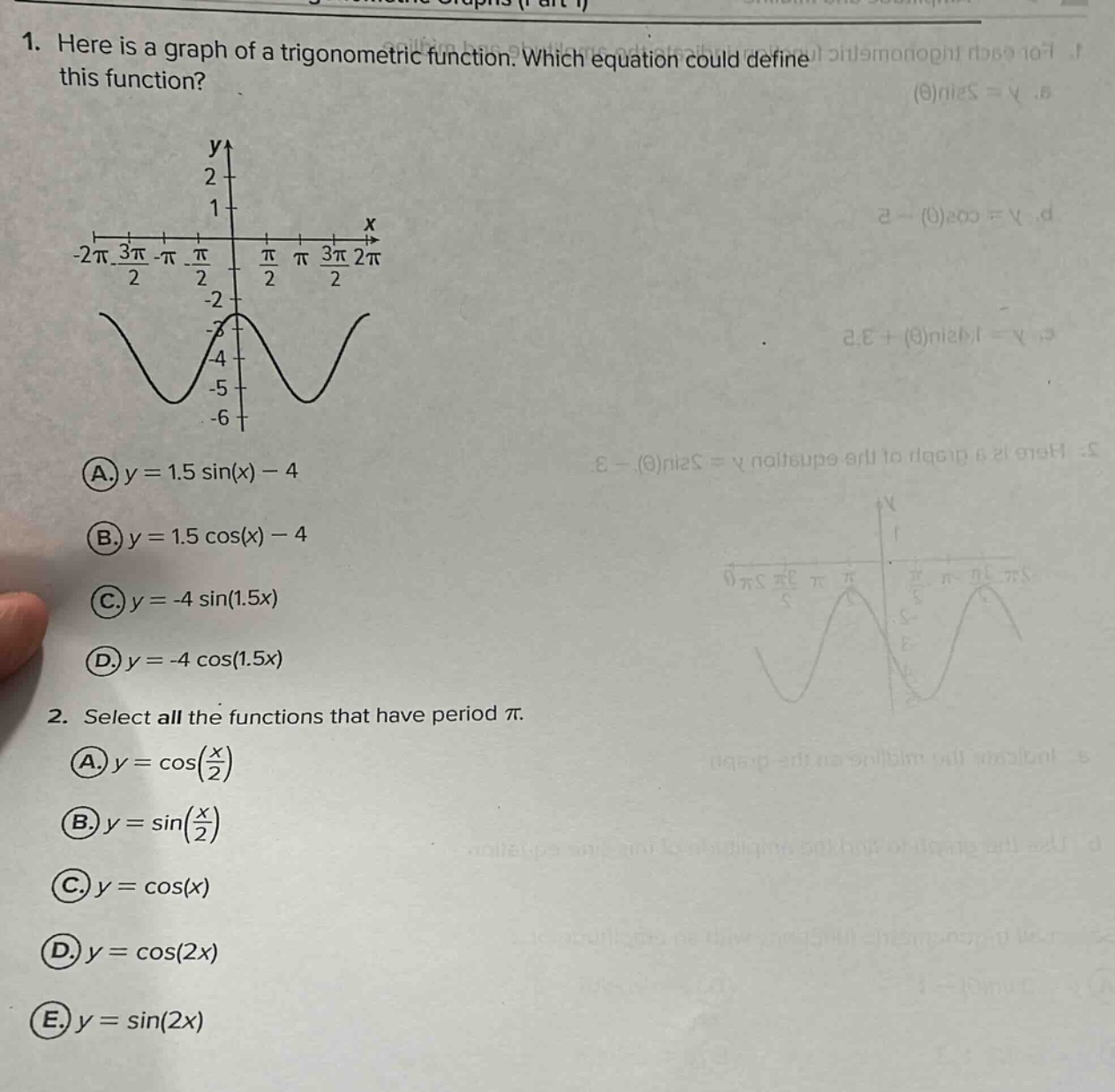
1. here is a graph of a trigonometric function. which equation could define this function?\na. $y = 1.5sin(x)-4$\nb. $y = 1.5cos(x)-4$\nc. $y=-4sin(1.5x)$\nd. $y = -4cos(1.5x)$\n2. select all the functions that have period $pi$.\na. $y=cos(\frac{x}{2})$\nb. $y=sin(\frac{x}{2})$\nc. $y=cos(x)$\nd. $y=cos(2x)$\ne. $y=sin(2x)$
Answer
Explanation:
Step1: Analyze amplitude and vertical - shift for question 1
For a trigonometric function of the form $y = A\sin(Bx - C)+D$ or $y=A\cos(Bx - C)+D$, the amplitude is $|A|$ and the vertical - shift is $D$. From the graph in question 1, the mid - line is at $y=-4$, so $D = - 4$. The amplitude (distance from the mid - line to the maximum or minimum) is $1.5$. When $x = 0$, the function value is at the mid - line for a sine function or at an extreme for a cosine function. Since the graph passes through the mid - line at $x = 0$, it is a sine function. So the equation is $y=1.5\sin(x)-4$.
Step2: Recall period formula for question 2
The period of a trigonometric function $y = A\sin(Bx - C)+D$ or $y = A\cos(Bx - C)+D$ is given by $T=\frac{2\pi}{|B|}$. For option A, if $y=\cos(\frac{x}{2})$, then $B=\frac{1}{2}$, and $T=\frac{2\pi}{\frac{1}{2}} = 4\pi$. For option B, if $y=\sin(\frac{x}{2})$, then $B=\frac{1}{2}$, and $T = 4\pi$. For option C, if $y=\cos(x)$, then $B = 1$, and $T=2\pi$. For option D, if $y=\cos(2x)$, then $B = 2$, and $T=\frac{2\pi}{2}=\pi$. For option E, if $y=\sin(2x)$, then $B = 2$, and $T=\frac{2\pi}{2}=\pi$.
Answer:
- A. $y = 1.5\sin(x)-4$
- D. $y=\cos(2x)$, E. $y=\sin(2x)$