3.) here is a graph of a trigonometric function. which equation does the graph represent? a: $y =…
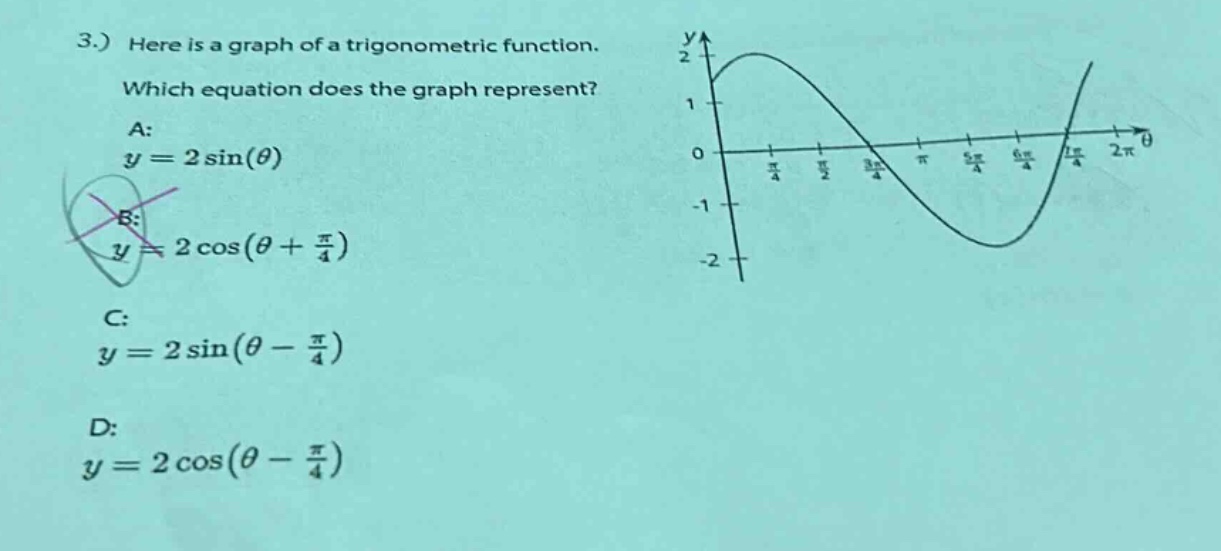
3.) here is a graph of a trigonometric function. which equation does the graph represent? a: $y = 2sin(\theta)$ b: $y = 2cos(\theta+\frac{pi}{4})$ c: $y = 2sin(\theta - \frac{pi}{4})$ d: $y = 2cos(\theta - \frac{pi}{4})$
Answer
Explanation:
Step1: Identify the amplitude
The maximum value of the function is 2 and the minimum is - 2. The amplitude $A$ of a trig - function $y = A\sin(\theta)$ or $y=A\cos(\theta)$ is given by $A=\frac{\text{max}-\text{min}}{2}$. Here, $A = \frac{2 - (-2)}{2}=2$.
Step2: Check the y - intercept
When $\theta = 0$, from the graph $y>1$. For option A: $y = 2\sin(0)=0$. For option B: $y = 2\cos(0+\frac{\pi}{4})=2\times\frac{\sqrt{2}}{2}=\sqrt{2}\approx1.414>1$. For option C: $y = 2\sin(0 - \frac{\pi}{4})=2\times(-\frac{\sqrt{2}}{2})=-\sqrt{2}<0$. For option D: $y = 2\cos(0-\frac{\pi}{4})=2\times\frac{\sqrt{2}}{2}=\sqrt{2}\approx1.414>1$.
Step3: Check the phase - shift
The general form of a cosine function is $y = A\cos(\theta-\varphi)$ and for a sine function is $y = A\sin(\theta-\varphi)$. The graph of $y = 2\cos(\theta+\frac{\pi}{4})$ has a phase - shift of $-\frac{\pi}{4}$ to the left. The graph of $y = 2\cos(\theta-\frac{\pi}{4})$ has a phase - shift of $\frac{\pi}{4}$ to the right. The cosine function $y = 2\cos(\theta+\frac{\pi}{4})$ matches the given graph.
Answer:
B. $y = 2\cos(\theta+\frac{\pi}{4})$