the graph of the trigonometric function f is shown above for a ≤ x ≤ b. at which of the following points on…
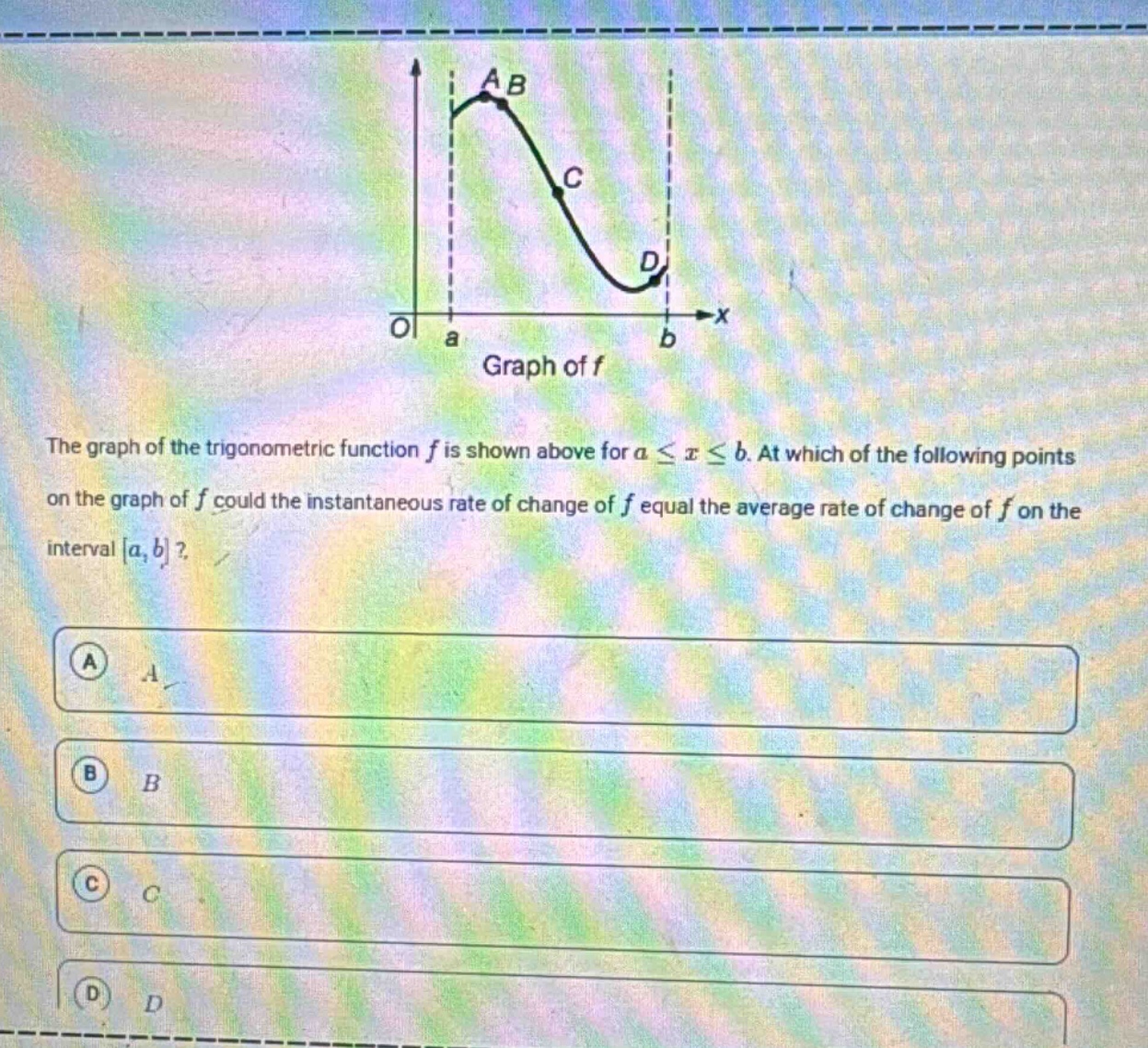
the graph of the trigonometric function f is shown above for a ≤ x ≤ b. at which of the following points on the graph of f could the instantaneous rate of change of f equal the average rate of change of f on the interval a, b? a a b b c c d d
Answer
Explanation:
Step1: Recall the Mean - Value Theorem
The Mean - Value Theorem states that if a function (y = f(x)) is continuous on the closed interval ([a,b]) and differentiable on the open interval ((a,b)), then there exists at least one point (c\in(a,b)) such that (f^{\prime}(c)=\frac{f(b)-f(a)}{b - a}), where (f^{\prime}(c)) is the instantaneous rate of change at (x = c) and (\frac{f(b)-f(a)}{b - a}) is the average rate of change on ([a,b]). Geometrically, the average rate of change (\frac{f(b)-f(a)}{b - a}) is the slope of the secant line connecting the points ((a,f(a))) and ((b,f(b))), and the instantaneous rate of change (f^{\prime}(c)) is the slope of the tangent line at (x = c).
Step2: Analyze the slopes at points A, B, C, and D
- At point A: The tangent line at A has a positive slope.
- At point B: The tangent line at B has a slope of 0.
- At point C: The slope of the tangent line at C is equal to the slope of the secant line connecting the endpoints of the interval ([a,b]) (by visually observing the parallel - ness of the tangent line at C and the secant line between ((a,f(a))) and ((b,f(b)))).
- At point D: The tangent line at D has a negative slope.
Answer:
C. C