graph the trigonometric function. y = -3/2 sin(3/2 x) plot all points corresponding to x - intercepts…
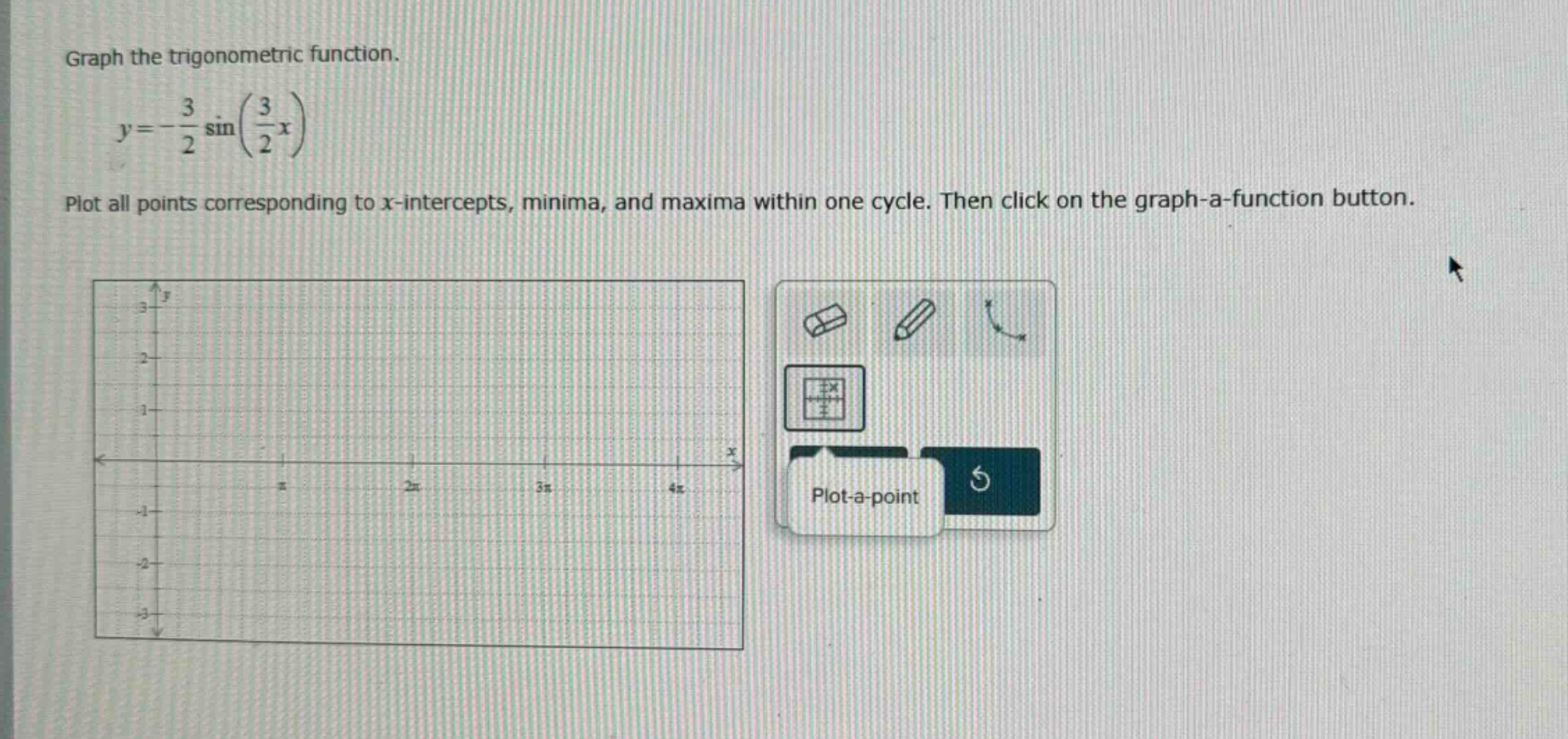
graph the trigonometric function. y = -3/2 sin(3/2 x) plot all points corresponding to x - intercepts, minima, and maxima within one cycle. then click on the graph - a - function button.
Answer
Explanation:
Step1: Find the period
The general form of a sine - function is $y = A\sin(Bx - C)+D$. For the function $y =-\frac{3}{2}\sin(\frac{3}{2}x)$, $B=\frac{3}{2}$. The period $T$ of a sine - function is given by $T=\frac{2\pi}{|B|}$. So, $T=\frac{2\pi}{\frac{3}{2}}=\frac{4\pi}{3}$.
Step2: Find the x - intercepts
Set $y = 0$. Then $-\frac{3}{2}\sin(\frac{3}{2}x)=0$, which implies $\sin(\frac{3}{2}x)=0$. So, $\frac{3}{2}x = k\pi$, where $k\in\mathbb{Z}$. Solving for $x$, we get $x=\frac{2k\pi}{3}$. For one - cycle ($0\leq x\leq\frac{4\pi}{3}$), when $k = 0$, $x = 0$; when $k = 1$, $x=\frac{2\pi}{3}$; when $k = 2$, $x=\frac{4\pi}{3}$.
Step3: Find the maxima and minima
The amplitude of the function $y =-\frac{3}{2}\sin(\frac{3}{2}x)$ is $|A|=\frac{3}{2}$. For a sine function $y = A\sin(Bx)$, the maxima occur when $\sin(Bx)=1$ and minima occur when $\sin(Bx)= - 1$. Set $\frac{3}{2}x=\frac{\pi}{2}+2k\pi$ for maxima. Solving for $x$, we get $x=\frac{\pi}{3}+\frac{4k\pi}{3}$. In the interval $[0,\frac{4\pi}{3}]$, when $k = 0$, $x=\frac{\pi}{3}$, and $y=-\frac{3}{2}\times1=-\frac{3}{2}$ (a minimum since $A=-\frac{3}{2}<0$). Set $\frac{3}{2}x=\frac{3\pi}{2}+2k\pi$ for minima. Solving for $x$, we get $x=\pi+\frac{4k\pi}{3}$. In the interval $[0,\frac{4\pi}{3}]$, when $k = 0$, $x=\pi$, and $y=-\frac{3}{2}\times(-1)=\frac{3}{2}$ (a maximum).
The points to plot within one - cycle ($0\leq x\leq\frac{4\pi}{3}$) are:
- X - intercepts: $(0,0),(\frac{2\pi}{3},0),(\frac{4\pi}{3},0)$
- Minimum: $(\frac{\pi}{3},-\frac{3}{2})$
- Maximum: $(\pi,\frac{3}{2})$
Answer:
The points to plot within one cycle are $(0,0),(\frac{\pi}{3},-\frac{3}{2}),(\frac{2\pi}{3},0),(\pi,\frac{3}{2}),(\frac{4\pi}{3},0)$