graph two full periods of the function. f(x) = 3 cos(πx)
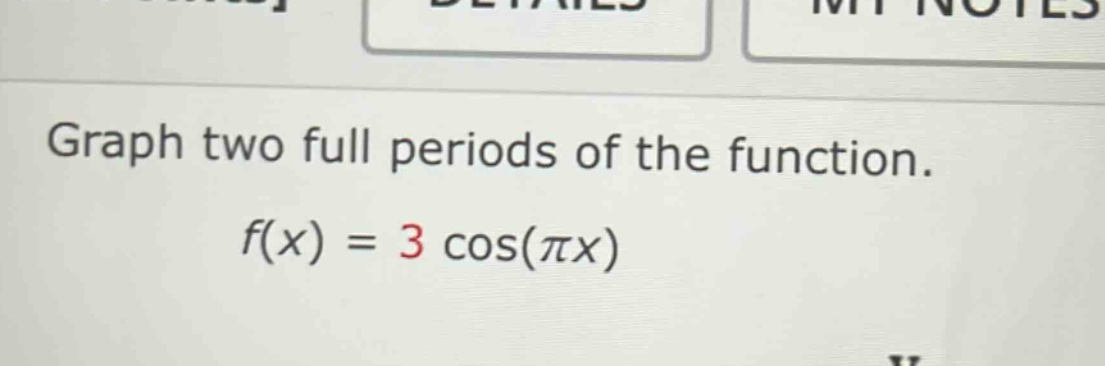
graph two full periods of the function. f(x) = 3 cos(πx)
Answer
Explanation:
Step1: Recall cosine - function properties
The general form of a cosine function is $y = A\cos(Bx - C)+D$. For the function $f(x)=3\cos(\pi x)$, we have $A = 3$, $B=\pi$, $C = 0$, and $D = 0$. The amplitude $|A|$ gives the vertical stretch factor, and here the amplitude $|A|=3$. The period of a cosine function $y = A\cos(Bx - C)+D$ is given by $T=\frac{2\pi}{|B|}$.
Step2: Calculate the period
Substitute $B = \pi$ into the period formula $T=\frac{2\pi}{|B|}$. We get $T=\frac{2\pi}{\pi}=2$.
Step3: Find key - points for one period
For the cosine function $y=\cos(x)$, key - points in one period $[0, 2\pi]$ are $(0,1),(\frac{\pi}{2},0),(\pi,- 1),(\frac{3\pi}{2},0),(2\pi,1)$. For the function $y = 3\cos(\pi x)$, when $x = 0$, $y=3\cos(0)=3$; when $x=\frac{1}{2}$, $y = 3\cos(\frac{\pi}{2})=0$; when $x = 1$, $y=3\cos(\pi)=-3$; when $x=\frac{3}{2}$, $y = 3\cos(\frac{3\pi}{2})=0$; when $x = 2$, $y=3\cos(2\pi)=3$.
Step4: Graph two periods
To graph two periods, we consider the interval $[0,4]$. Plot the points $(0,3),(\frac{1}{2},0),(1,-3),(\frac{3}{2},0),(2,3),(\frac{5}{2},0),(3,-3),(\frac{7}{2},0),(4,3)$ and connect them with a smooth curve.
Answer:
Graph the points $(0,3),(\frac{1}{2},0),(1,-3),(\frac{3}{2},0),(2,3),(\frac{5}{2},0),(3,-3),(\frac{7}{2},0),(4,3)$ and connect them with a smooth cosine - shaped curve for the function $y = 3\cos(\pi x)$ over the interval $[0,4]$.