graph two periods of the given tangent function.\ny = tan(x + \\frac{\\pi}{4})\nchoose the correct graph of…
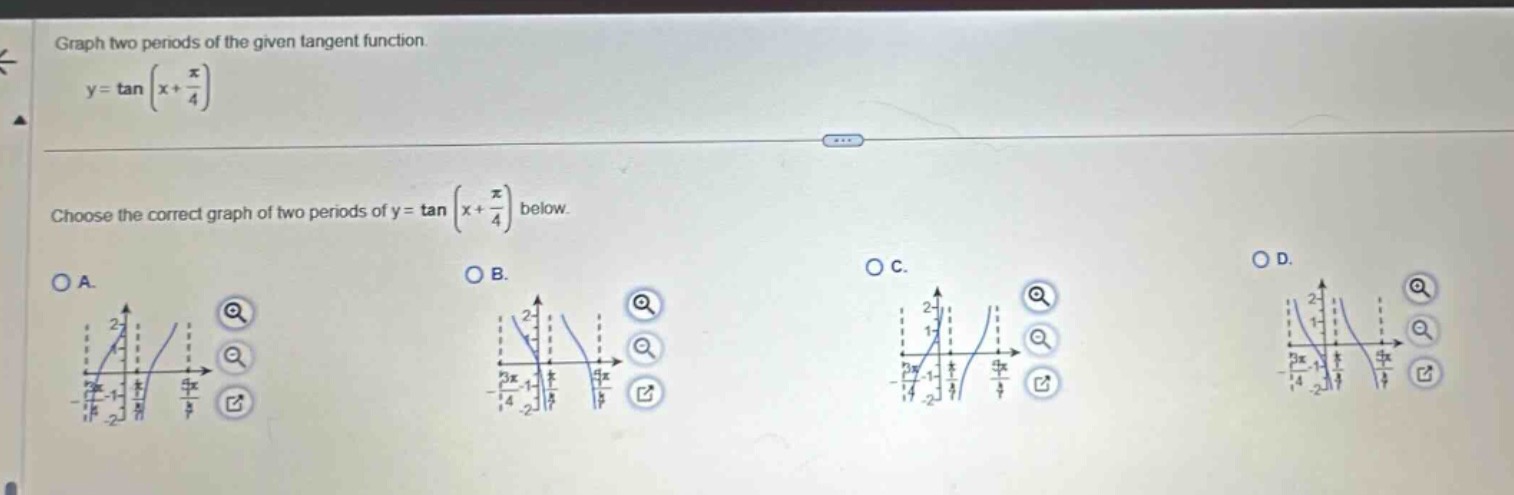
graph two periods of the given tangent function.\ny = tan(x + \\frac{\\pi}{4})\nchoose the correct graph of two periods of y = tan(x + \\frac{\\pi}{4}) below.
Answer
Explanation:
Step1: Recall the properties of the tangent - function
The general form of the tangent function is $y = A\tan(Bx - C)+D$. For the function $y=\tan(x + \frac{\pi}{4})$, we have $A = 1$, $B = 1$, $C=-\frac{\pi}{4}$, and $D = 0$. The period of the tangent function $y=\tan(Bx - C)$ is given by $T=\frac{\pi}{|B|}$. Since $B = 1$, the period $T=\pi$.
Step2: Find the vertical asymptotes
The vertical asymptotes of the tangent function $y = \tan(x)$ occur at $x=(n+\frac{1}{2})\pi$, $n\in\mathbb{Z}$. For the function $y=\tan(x+\frac{\pi}{4})$, we set $x+\frac{\pi}{4}=(n + \frac{1}{2})\pi$. Solving for $x$, we get $x=(n+\frac{1}{2})\pi-\frac{\pi}{4}=n\pi+\frac{\pi}{4}$, $n\in\mathbb{Z}$. When $n = - 1$, $x=-\frac{3\pi}{4}$; when $n = 0$, $x=\frac{\pi}{4}$; when $n = 1$, $x=\frac{5\pi}{4}$.
Step3: Find the $x$ - intercept
Set $y = 0$, so $\tan(x+\frac{\pi}{4})=0$. Then $x+\frac{\pi}{4}=n\pi$, $n\in\mathbb{Z}$, and $x=n\pi-\frac{\pi}{4}$. When $n = 0$, $x=-\frac{\pi}{4}$. The graph of $y = \tan(x)$ is shifted to the left by $\frac{\pi}{4}$ units. The tangent function passes through the point $(-\frac{\pi}{4},0)$ and has vertical asymptotes at $x=-\frac{3\pi}{4}$ and $x=\frac{\pi}{4}$ for one - period, and at $x=\frac{\pi}{4}$ and $x=\frac{5\pi}{4}$ for the next period.
Answer:
The correct graph can be identified by checking the position of the vertical asymptotes and the $x$ - intercept. Without seeing the actual details of the graphs A, B, C, and D, the key features to look for are: vertical asymptotes at $x = n\pi+\frac{\pi}{4},n\in\mathbb{Z}$ and $x$ - intercepts at $x=n\pi-\frac{\pi}{4},n\in\mathbb{Z}$. If we assume the standard orientation and scale of the graphs, we need to find the graph that has vertical asymptotes at $x =-\frac{3\pi}{4},\frac{\pi}{4},\frac{5\pi}{4}$ and passes through $(-\frac{\pi}{4},0)$.