a graphing calculator is recommended. a digital delay device echoes an input signal by repeating it a fixed…
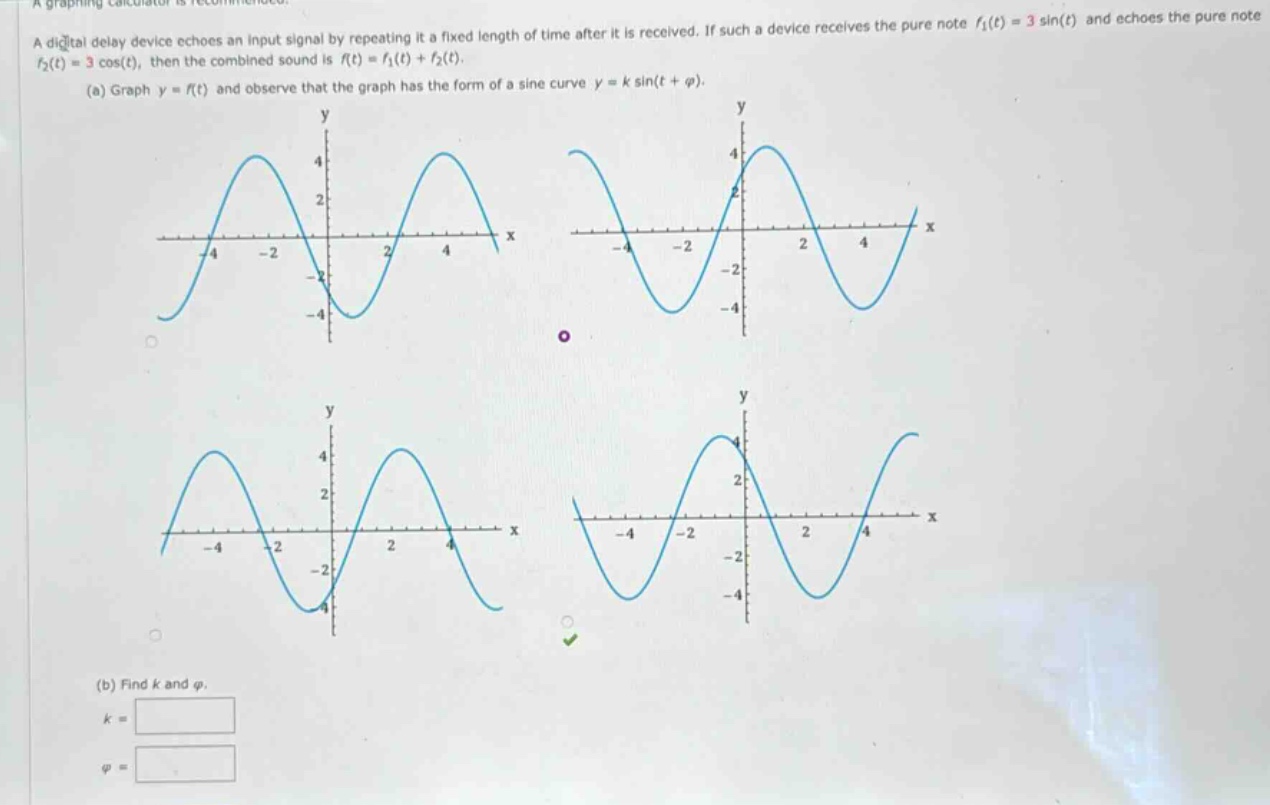
a graphing calculator is recommended. a digital delay device echoes an input signal by repeating it a fixed length of time after it is received. if such a device receives the pure note f1(t)=3sin(t) and echoes the pure note f2(t)=3cos(t), then the combined sound is f(t)=f1(t)+f2(t). (a) graph y = f(t) and observe that the graph has the form of a sine curve y = k sin(t + φ). (b) find k and φ. k = φ =
Answer
Explanation:
Step1: Express (f(t))
We know (f(t)=f_1(t)+f_2(t)), where (f_1(t) = 3\sin(t)) and (f_2(t)=3\cos(t)), so (f(t)=3\sin(t)+ 3\cos(t)). We want to rewrite it in the form (y = k\sin(t+\varphi)=k(\sin(t)\cos(\varphi)+\cos(t)\sin(\varphi))=k\cos(\varphi)\sin(t)+k\sin(\varphi)\cos(t)).
Step2: Equate coefficients
We have the system of equations (\begin{cases}k\cos(\varphi)=3\k\sin(\varphi)=3\end{cases}). Squaring both - equations and adding them: ((k\cos(\varphi))^2+(k\sin(\varphi))^2 = 3^2 + 3^2). Using the identity (\sin^{2}\alpha+\cos^{2}\alpha = 1), we get (k^{2}(\cos^{2}\varphi+\sin^{2}\varphi)=9 + 9), so (k^{2}=18), and (k = 3\sqrt{2}) (since (k>0)).
Step3: Find (\varphi)
Dividing the second - equation (k\sin(\varphi)=3) by the first - equation (k\cos(\varphi)=3), we get (\tan(\varphi)=1). Since (k\cos(\varphi)=3>0) and (k\sin(\varphi)=3>0), (\varphi=\frac{\pi}{4}) (in the first quadrant).
Answer:
(k = 3\sqrt{2}) (\varphi=\frac{\pi}{4})