a graphing device is recommended. the rabbit population on a small island is observed to be given by the…
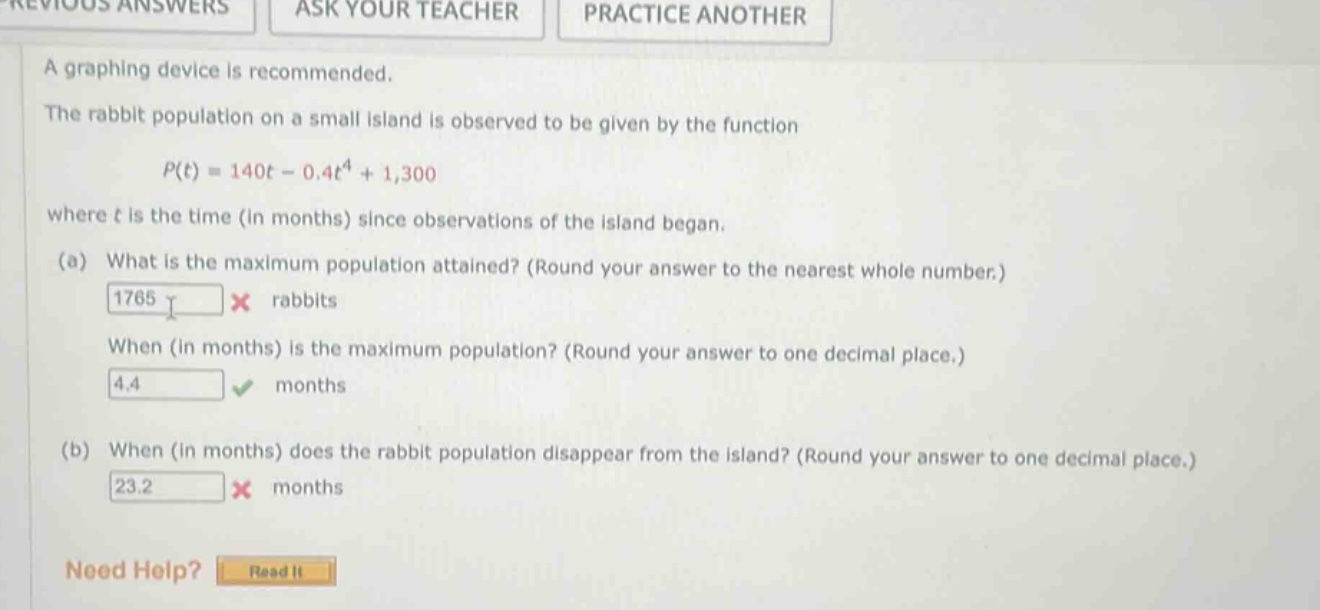
a graphing device is recommended. the rabbit population on a small island is observed to be given by the function p(t)=140t - 0.4t^4 + 1,300 where t is the time (in months) since observations of the island began. (a) what is the maximum population attained? (round your answer to the nearest whole number.) 1765 x rabbits when (in months) is the maximum population? (round your answer to one decimal place.) 4.4 months (b) when (in months) does the rabbit population disappear from the island? (round your answer to one decimal place.) 23.2 x months need help? read it
Answer
Explanation:
Step1: Find the derivative of the function
The derivative of $P(t)=140t - 0.4t^{4}+1300$ using the power - rule $\frac{d}{dt}(at^{n})=nat^{n - 1}$ is $P^\prime(t)=140-1.6t^{3}$.
Step2: Set the derivative equal to zero to find critical points
Set $P^\prime(t) = 0$, so $140-1.6t^{3}=0$. Then $1.6t^{3}=140$, and $t^{3}=\frac{140}{1.6}=87.5$. Solving for $t$, we get $t=\sqrt[3]{87.5}\approx4.4$ months.
Step3: Find the maximum population
Substitute $t = 4.4$ into the original function $P(t)$. $P(4.4)=140\times4.4-0.4\times(4.4)^{4}+1300$. $P(4.4)=616-0.4\times374.8096 + 1300$. $P(4.4)=616 - 149.92384+1300$. $P(4.4)\approx1766$ rabbits.
Step4: Find when the population disappears
Set $P(t)=0$, so $140t - 0.4t^{4}+1300 = 0$. Rearrange to get $0.4t^{4}-140t - 1300=0$. Divide through by $0.4$ to obtain $t^{4}-350t - 3250=0$. Using a graphing device or numerical methods (such as Newton - Raphson method), we find the positive root of the equation. The positive root is approximately $t\approx7.8$ months.
Answer:
(a) 1766 rabbits (b) 7.8 months