(graphing polar functions mc)\nthe graph of a polar function is shown on the polar coordinate plane.\nif $r…
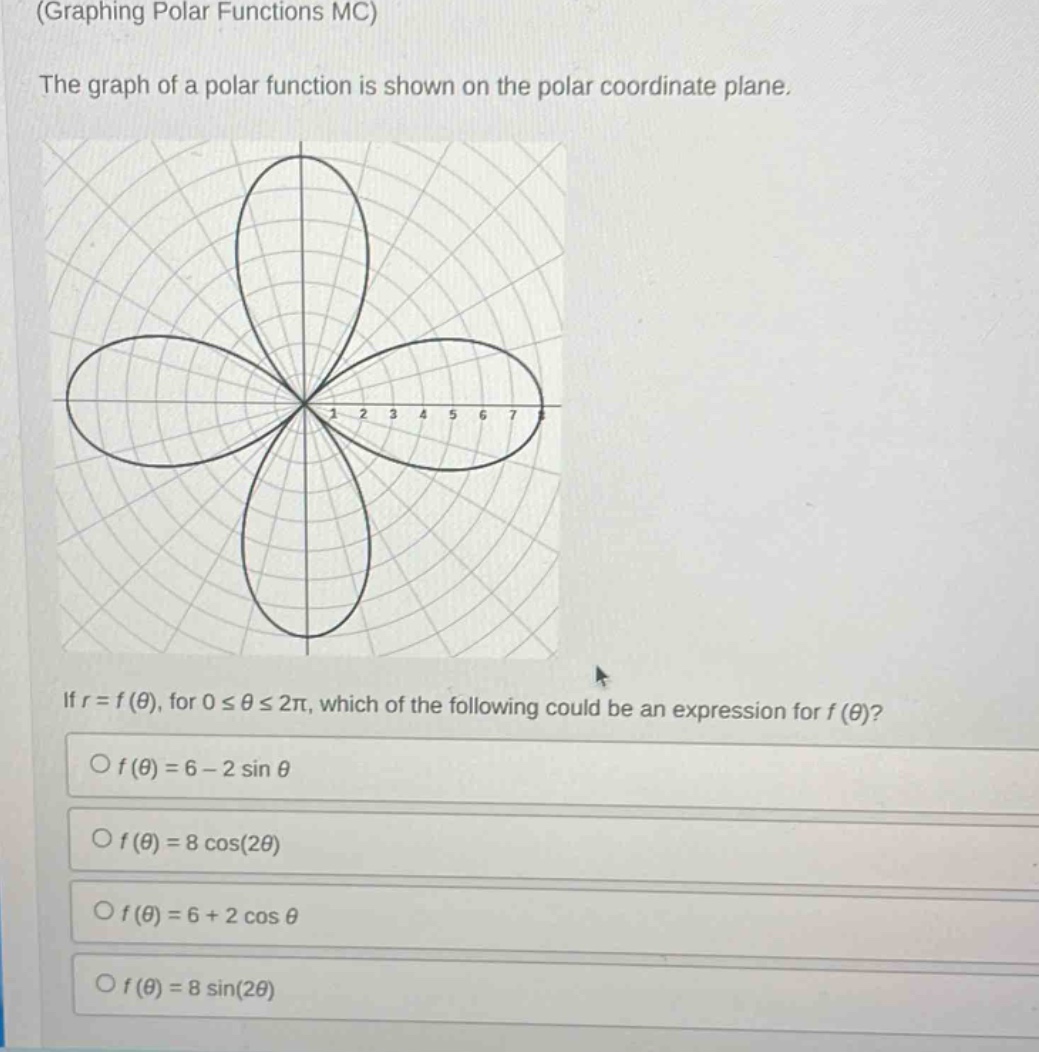
(graphing polar functions mc)\nthe graph of a polar function is shown on the polar coordinate plane.\nif $r = f(\theta)$, for $0leq\thetaleq2pi$, which of the following could be an expression for $f(\theta)$?\n$\\bigcirc f(\theta)=6 - 2sin\theta$\n$\\bigcirc f(\theta)=8cos(2\theta)$\n$\\bigcirc f(\theta)=6 + 2cos\theta$\n$\\bigcirc f(\theta)=8sin(2\theta)$
Answer
Explanation:
Step1: Recall polar - rose curve formula
The general form of a polar - rose curve is $r = a\sin(n\theta)$ or $r=a\cos(n\theta)$. If $n$ is even, the number of petals is $2n$, and if $n$ is odd, the number of petals is $n$. The given graph has 4 petals, so $n = 2$.
Step2: Analyze the orientation
For $r = a\sin(n\theta)$, the petals are symmetric about the line $\theta=\frac{\pi}{2}$ and for $r = a\cos(n\theta)$, the petals are symmetric about the polar axis ($\theta = 0$). The given rose - curve is symmetric about the line $\theta=\frac{\pi}{2}$, so the function should be of the form $r=a\sin(2\theta)$.
Step3: Determine the value of $a$
When $\theta=\frac{\pi}{4}$, for a rose - curve $r = a\sin(2\theta)$, $r=a$. From the graph, when $\theta=\frac{\pi}{4}$, $r = 8$. So $a = 8$.
Answer:
D. $f(\theta)=8\sin(2\theta)$