2.6 graphing rational functions assignment\nfor the following exercises. a) find any x and y intercepts b)…
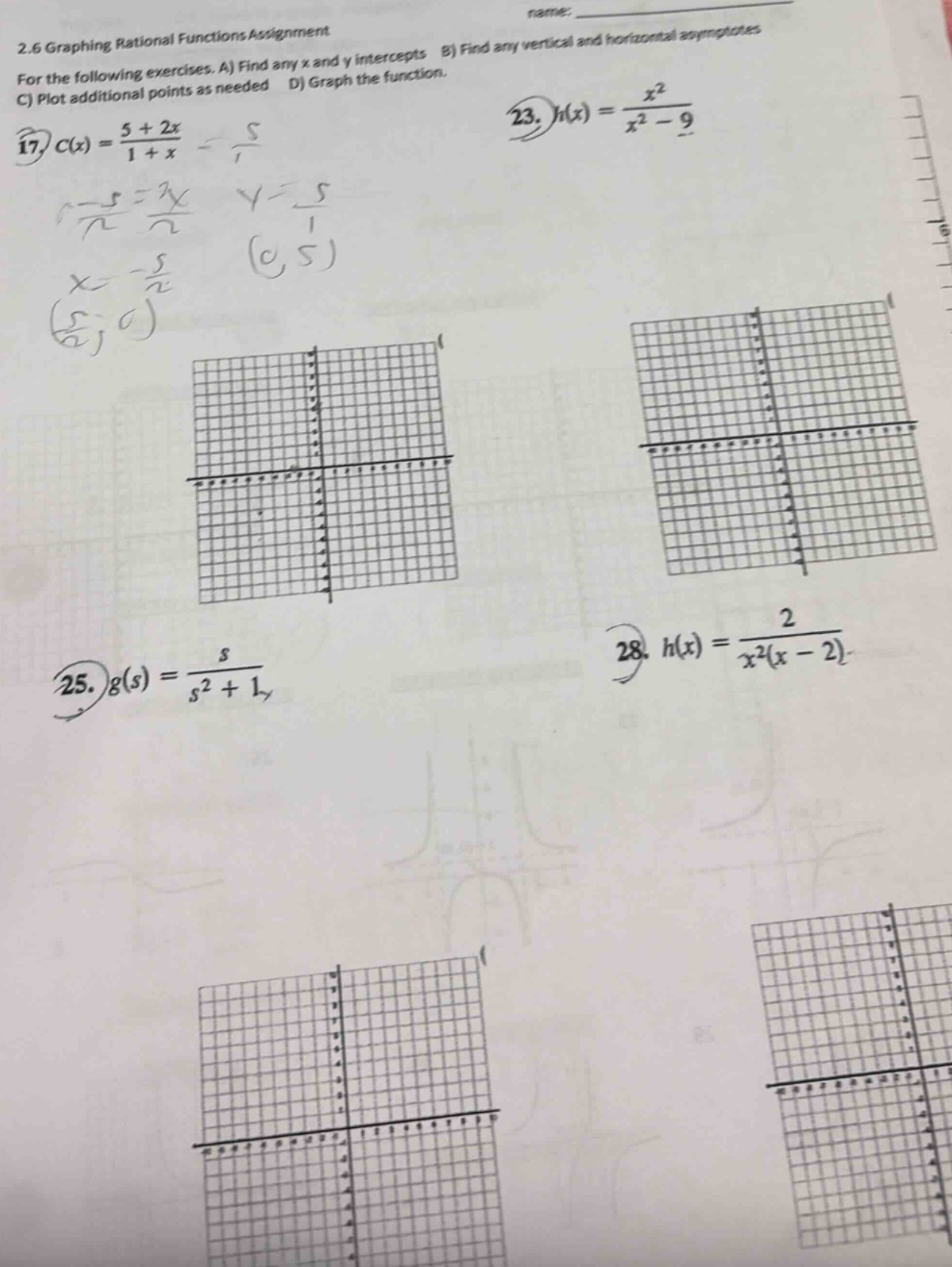
2.6 graphing rational functions assignment\nfor the following exercises. a) find any x and y intercepts b) find any vertical and horizontal asymptotes\nc) plot additional points as needed d) graph the function.\n17) $c(x)=\frac{5 + 2x}{1 + x}$\n23) $h(x)=\frac{x^{2}}{x^{2}-9}$\n25) $g(s)=\frac{s}{s^{2}+1}$\n28) $h(x)=\frac{2}{x^{2}(x - 2)}$
Answer
Problem 17: $C(x) = \frac{5+2x}{1+x}$
Explanation:
Step 1: Find y-intercept
Set $x=0$: $C(0) = \frac{5+2(0)}{1+0} = \frac{5}{1} = 5$ The y-intercept is $(0, 5)$.
Step 2: Find x-intercept
Set $C(x)=0$: $\frac{5+2x}{1+x} = 0 \implies 5+2x = 0 \implies 2x = -5 \implies x = -\frac{5}{2}$ The x-intercept is $(-\frac{5}{2}, 0)$.
Step 3: Find Vertical Asymptote
Set denominator to zero: $1+x = 0 \implies x = -1$ The vertical asymptote is $x=-1$.
Step 4: Find Horizontal Asymptote
Compare degrees of numerator (1) and denominator (1). They are equal. $y = \frac{\text{leading coefficient of numerator}}{\text{leading coefficient of denominator}} = \frac{2}{1} = 2$ The horizontal asymptote is $y=2$.
Step 5: Plot Additional Points
Let $x=-2$: $C(-2) = \frac{5+2(-2)}{1+(-2)} = \frac{1}{-1} = -1$. Point: $(-2, -1)$. Let $x=1$: $C(1) = \frac{5+2(1)}{1+1} = \frac{7}{2} = 3.5$. Point: $(1, 3.5)$.
Step 6: Graph the Function
Plot the intercepts, asymptotes, additional points, and sketch the curve.
Answer:
For $C(x) = \frac{5+2x}{1+x}$: A) y-intercept: $(0, 5)$, x-intercept: $(-\frac{5}{2}, 0)$ B) Vertical Asymptote: $x=-1$, Horizontal Asymptote: $y=2$ C) Additional Points: e.g., $(-2, -1)$, $(1, 3.5)$ D) The graph consists of two branches separated by the asymptotes, passing through the calculated points.
Problem 23: $h(x) = \frac{x^2}{x^2-9}$
Explanation:
Step 1: Find y-intercept
Set $x=0$: $h(0) = \frac{0^2}{0^2-9} = \frac{0}{-9} = 0$ The y-intercept is $(0, 0)$.
Step 2: Find x-intercept
Set $h(x)=0$: $\frac{x^2}{x^2-9} = 0 \implies x^2 = 0 \implies x = 0$ The x-intercept is $(0, 0)$.
Step 3: Find Vertical Asymptotes
Set denominator to zero: $x^2-9 = 0 \implies (x-3)(x+3) = 0 \implies x = 3, x = -3$ The vertical asymptotes are $x=3$ and $x=-3$.
Step 4: Find Horizontal Asymptote
Compare degrees of numerator (2) and denominator (2). They are equal. $y = \frac{\text{leading coefficient of numerator}}{\text{leading coefficient of denominator}} = \frac{1}{1} = 1$ The horizontal asymptote is $y=1$.
Step 5: Plot Additional Points
Let $x=2$: $h(2) = \frac{2^2}{2^2-9} = \frac{4}{4-9} = -\frac{4}{5}$. Point: $(2, -0.8)$. Let $x=-2$: $h(-2) = \frac{(-2)^2}{(-2)^2-9} = \frac{4}{4-9} = -\frac{4}{5}$. Point: $(-2, -0.8)$. Let $x=4$: $h(4) = \frac{4^2}{4^2-9} = \frac{16}{16-9} = \frac{16}{7}$. Point: $(4, \frac{16}{7})$. Let $x=-4$: $h(-4) = \frac{(-4)^2}{(-4)^2-9} = \frac{16}{16-9} = \frac{16}{7}$. Point: $(-4, \frac{16}{7})$.
Step 6: Graph the Function
Plot the intercept, asymptotes, additional points, and sketch the curve. Note symmetry about the y-axis.
Answer:
For $h(x) = \frac{x^2}{x^2-9}$: A) y-intercept: $(0, 0)$, x-intercept: $(0, 0)$ B) Vertical Asymptotes: $x=3$, $x=-3$, Horizontal Asymptote: $y=1$ C) Additional Points: e.g., $(2, -0.8)$, $(-2, -0.8)$, $(4, \frac{16}{7})$, $(-4, \frac{16}{7})$ D) The graph consists of three branches separated by the vertical asymptotes, passing through the calculated points.
Problem 25: $g(s) = \frac{s}{s^2+1}$ (using x: $g(x) = \frac{x}{x^2+1}$)
Explanation:
Step 1: Find y-intercept
Set $x=0$: $g(0) = \frac{0}{0^2+1} = 0$ The y-intercept is $(0, 0)$.
Step 2: Find x-intercept
Set $g(x)=0$: $\frac{x}{x^2+1} = 0 \implies x = 0$ The x-intercept is $(0, 0)$.
Step 3: Find Vertical Asymptotes
Set denominator to zero: $x^2+1 = 0$. This equation has no real solutions since $x^2 \ge 0$ for all real $x$, thus $x^2+1 \ge 1$. There are no vertical asymptotes.
Step 4: Find Horizontal Asymptote
Compare degrees of numerator (1) and denominator (2). Degree of numerator < Degree of denominator. The horizontal asymptote is $y=0$.
Step 5: Plot Additional Points
Let $x=1$: $g(1) = \frac{1}{1^2+1} = \frac{1}{2}$. Point: $(1, 0.5)$. Let $x=-1$: $g(-1) = \frac{-1}{(-1)^2+1} = -\frac{1}{2}$. Point: $(-1, -0.5)$. Let $x=2$: $g(2) = \frac{2}{2^2+1} = \frac{2}{5}$. Point: $(2, 0.4)$. Let $x=-2$: $g(-2) = \frac{-2}{(-2)^2+1} = -\frac{2}{5}$. Point: $(-2, -0.4)$.
Step 6: Graph the Function
Plot the intercept, asymptote, additional points, and sketch the curve. Note symmetry about the origin.
Answer:
For $g(x) = \frac{x}{x^2+1}$: A) y-intercept: $(0, 0)$, x-intercept: $(0, 0)$ B) Vertical Asymptotes: None, Horizontal Asymptote: $y=0$ C) Additional Points: e.g., $(1, 0.5)$, $(-1, -0.5)$, $(2, 0.4)$, $(-2, -0.4)$ D) The graph is a single curve passing through the origin, approaching the x-axis as $x \to \pm \infty$.
Problem 28: $h(x) = \frac{2}{x^2(x-2)}$
Explanation:
Step 1: Find y-intercept
Set $x=0$: $h(0) = \frac{2}{0^2(0-2)} = \frac{2}{0}$, which is undefined. There is no y-intercept.
Step 2: Find x-intercept
Set $h(x)=0$: $\frac{2}{x^2(x-2)} = 0$. The numerator is 2, which is never zero. There are no x-intercepts.
Step 3: Find Vertical Asymptotes
Set denominator to zero: $x^2(x-2) = 0 \implies x^2=0$ or $x-2=0 \implies x=0, x=2$ The vertical asymptotes are $x=0$ and $x=2$.
Step 4: Find Horizontal Asymptote
Compare degrees of numerator (0) and denominator (3). Degree of numerator < Degree of denominator. The horizontal asymptote is $y=0$.
Step 5: Plot Additional Points
Let $x=-1$: $h(-1) = \frac{2}{(-1)^2(-1-2)} = \frac{2}{1(-3)} = -\frac{2}{3}$. Point: $(-1, -\frac{2}{3})$. Let $x=1$: $h(1) = \frac{2}{1^2(1-2)} = \frac{2}{1(-1)} = -2$. Point: $(1, -2)$. Let $x=3$: $h(3) = \frac{2}{3^2(3-2)} = \frac{2}{9(1)} = \frac{2}{9}$. Point: $(3, \frac{2}{9})$. Let $x=-2$: $h(-2) = \frac{2}{(-2)^2(-2-2)} = \frac{2}{4(-4)} = -\frac{1}{8}$. Point: $(-2, -\frac{1}{8})$.
Step 6: Graph the Function
Plot the asymptotes, additional points, and sketch the curve. Analyze behavior near asymptotes ($x=0$ and $x=2$).
Answer:
For $h(x) = \frac{2}{x^2(x-2)}$: A) y-intercept: None, x-intercept: None B) Vertical Asymptotes: $x=0$, $x=2$, Horizontal Asymptote: $y=0$ C) Additional Points: e.g., $(-1, -\frac{2}{3})$, $(1, -2)$, $(3, \frac{2}{9})$, $(-2, -\frac{1}{8})$ D) The graph consists of three branches separated by the vertical asymptotes, passing through the calculated points.