4.2 graphing sine & cosine #1 graph each function over a two - period interval. 39) y = cos(x - π/2) 40) y =…
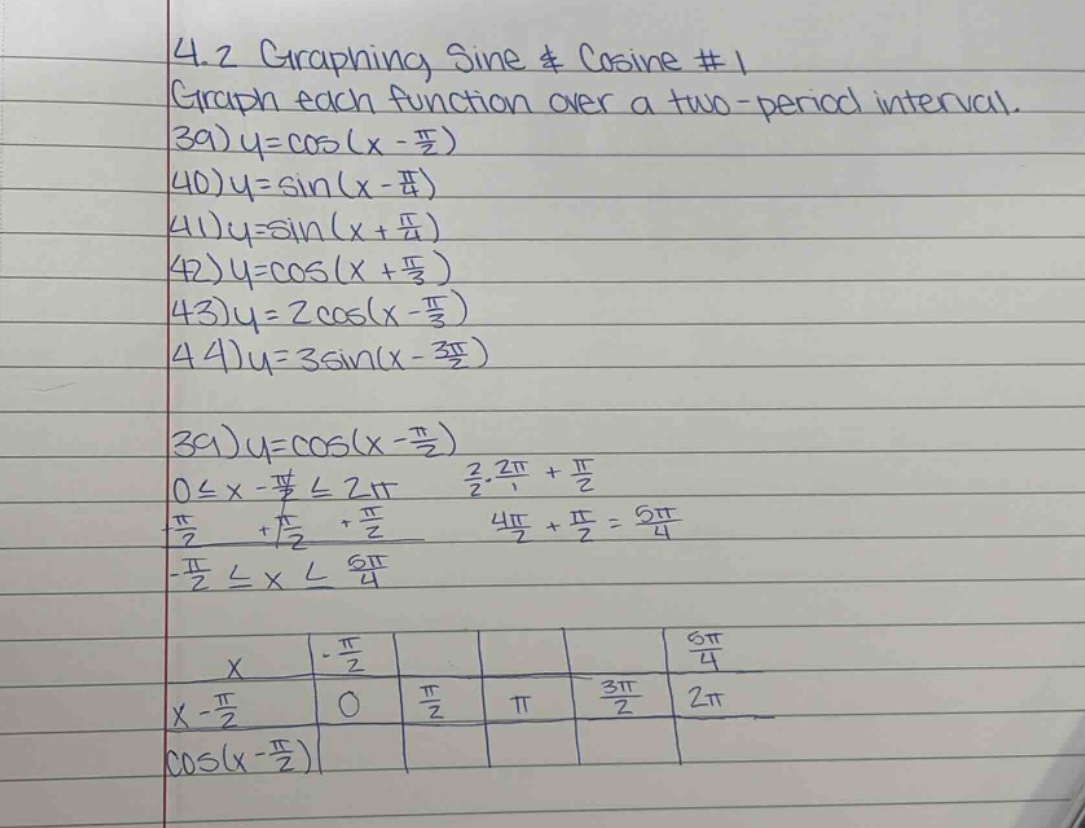
4.2 graphing sine & cosine #1 graph each function over a two - period interval. 39) y = cos(x - π/2) 40) y = sin(x - π/4) 41) y = sin(x + π/4) 42) y = cos(x + π/3) 43) y = 2cos(x - π/3) 44) y = 3sin(x - 3π/2) 39) y = cos(x - π/2) 0 ≤ x - π/2 ≤ 2π 2.2π/1 + π/2 π/2 + π/2 + π/2 4π/2 + π/2 = 5π/4 -π/2 ≤ x ≤ 5π/4 x -π/2 0 π/2 π 3π/2 2π cos(x - π/2)
Answer
Explanation:
Step1: Recall the period of cosine and sine functions
The period of $y = A\sin(Bx - C)+D$ and $y=A\cos(Bx - C)+D$ is $T=\frac{2\pi}{|B|}$. For the given functions, $B = 1$, so the period $T = 2\pi$. We want to graph over a two - period interval.
Step2: For $y=\cos(x-\frac{\pi}{2})$
We know that $\cos(x-\frac{\pi}{2})=\sin x$ (using the co - function identity $\cos(A - \frac{\pi}{2})=\sin A$). To find the two - period interval, we set up the inequality for the argument of the cosine function: $0\leq x-\frac{\pi}{2}\leq4\pi$. Solving for $x$ gives $\frac{\pi}{2}\leq x\leq\frac{\pi}{2}+ 4\pi$. We can also make a table of values. Let $u=x-\frac{\pi}{2}$. When $u = 0,x=\frac{\pi}{2},y=\cos(0)=1$; when $u=\frac{\pi}{2},x=\pi,y = 0$; when $u=\pi,x=\frac{3\pi}{2},y=-1$; when $u=\frac{3\pi}{2},x = 2\pi,y = 0$; when $u = 2\pi,x=\frac{5\pi}{2},y=1$.
Step3: For $y=\sin(x - \frac{\pi}{4})$
The period is $2\pi$. Set up the inequality for the argument: $0\leq x-\frac{\pi}{4}\leq4\pi$. Solving for $x$ gives $\frac{\pi}{4}\leq x\leq\frac{\pi}{4}+4\pi$. We can find key points by choosing values for $x-\frac{\pi}{4}$ such as $0,\frac{\pi}{2},\pi,\frac{3\pi}{2},2\pi$ and then finding the corresponding $x$ and $y$ values. For example, when $x-\frac{\pi}{4}=0,x = \frac{\pi}{4},y=\sin(0)=0$; when $x-\frac{\pi}{4}=\frac{\pi}{2},x=\frac{3\pi}{4},y = 1$; when $x-\frac{\pi}{4}=\pi,x=\frac{5\pi}{4},y=0$; when $x-\frac{\pi}{4}=\frac{3\pi}{2},x=\frac{7\pi}{4},y=-1$; when $x-\frac{\pi}{4}=2\pi,x=\frac{9\pi}{4},y = 0$.
Step4: For $y=\sin(x+\frac{\pi}{6})$
The period is $2\pi$. Set $0\leq x+\frac{\pi}{6}\leq4\pi$. Solving for $x$ gives $-\frac{\pi}{6}\leq x\leq-\frac{\pi}{6}+4\pi$. Key points: when $x+\frac{\pi}{6}=0,x=-\frac{\pi}{6},y=\sin(0)=0$; when $x+\frac{\pi}{6}=\frac{\pi}{2},x=\frac{\pi}{3},y = 1$; when $x+\frac{\pi}{6}=\pi,x=\frac{5\pi}{6},y=0$; when $x+\frac{\pi}{6}=\frac{3\pi}{2},x=\frac{4\pi}{3},y=-1$; when $x+\frac{\pi}{6}=2\pi,x=\frac{11\pi}{6},y = 0$.
Step5: For $y=\cos(x+\frac{\pi}{3})$
The period is $2\pi$. Set $0\leq x+\frac{\pi}{3}\leq4\pi$. Solving for $x$ gives $-\frac{\pi}{3}\leq x\leq-\frac{\pi}{3}+4\pi$. Key points: when $x+\frac{\pi}{3}=0,x=-\frac{\pi}{3},y=\cos(0)=1$; when $x+\frac{\pi}{3}=\frac{\pi}{2},x=\frac{\pi}{6},y = 0$; when $x+\frac{\pi}{3}=\pi,x=\frac{2\pi}{3},y=-1$; when $x+\frac{\pi}{3}=\frac{3\pi}{2},x=\frac{7\pi}{6},y=0$; when $x+\frac{\pi}{3}=2\pi,x=\frac{5\pi}{3},y = 1$.
Step6: For $y = 2\cos(x-\frac{\pi}{3})$
The amplitude is $A = 2$ and the period is $2\pi$. Set $0\leq x-\frac{\pi}{3}\leq4\pi$. Solving for $x$ gives $\frac{\pi}{3}\leq x\leq\frac{\pi}{3}+4\pi$. Key points: when $x-\frac{\pi}{3}=0,x=\frac{\pi}{3},y=2\cos(0)=2$; when $x-\frac{\pi}{3}=\frac{\pi}{2},x=\frac{5\pi}{6},y = 0$; when $x-\frac{\pi}{3}=\pi,x=\frac{4\pi}{3},y=-2$; when $x-\frac{\pi}{3}=\frac{3\pi}{2},x=\frac{11\pi}{6},y=0$; when $x-\frac{\pi}{3}=2\pi,x=\frac{7\pi}{3},y = 2$.
Step7: For $y = 3\sin(x-\frac{3\pi}{2})$
First, simplify $y = 3\sin(x-\frac{3\pi}{2})=3\cos x$ (using the identity $\sin(A-\frac{3\pi}{2})=\cos A$). The amplitude is $A = 3$ and the period is $2\pi$. Set $0\leq x\leq4\pi$. Key points: when $x = 0,y=3\cos(0)=3$; when $x=\frac{\pi}{2},y = 0$; when $x=\pi,y=-3$; when $x=\frac{3\pi}{2},y=0$; when $x = 2\pi,y = 3$; when $x= \frac{5\pi}{2},y=0$; when $x=3\pi,y=-3$; when $x=\frac{7\pi}{2},y=0$; when $x = 4\pi,y = 3$.
To graph these functions, plot the key - points found in each step on the coordinate plane and connect them with a smooth curve for each function over the two - period interval.
Answer:
The graphs of the functions $y=\cos(x-\frac{\pi}{2}),y=\sin(x - \frac{\pi}{4}),y=\sin(x+\frac{\pi}{6}),y=\cos(x+\frac{\pi}{3}),y = 2\cos(x-\frac{\pi}{3}),y = 3\sin(x-\frac{3\pi}{2})$ can be obtained by following the steps above to find key - points and then connecting them with smooth curves over a two - period interval.