the graphs $f(x)=4x$ and $g(x)=4^{x}$ intersect at $x = \frac{1}{2}$ and $x = 1$. select all of the…
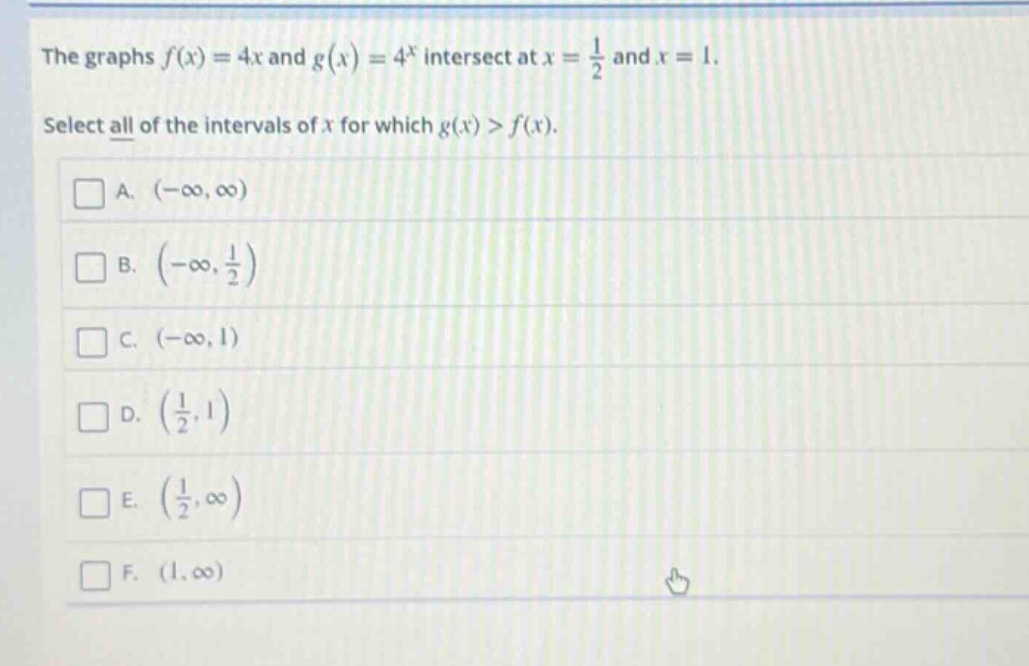
the graphs $f(x)=4x$ and $g(x)=4^{x}$ intersect at $x = \frac{1}{2}$ and $x = 1$. select all of the intervals of $x$ for which $g(x)>f(x)$. a. $(-infty,infty)$ b. $(-infty,\frac{1}{2})$ c. $(-infty,1)$ d. $(\frac{1}{2},1)$ e. $(\frac{1}{2},infty)$ f. $(1,infty)$
Answer
Explanation:
Step1: Analyze intersection points
We know (f(x) = 4x) and (g(x)=4^{x}) intersect at (x = \frac{1}{2}) and (x = 1). We can test values in the intervals separated by these intersection - points.
Step2: Test a value in ((-\infty,\frac{1}{2}))
Let (x = 0). Then (f(0)=4\times0 = 0) and (g(0)=4^{0}=1). Since (g(0)>f(0)), (g(x)>f(x)) on ((-\infty,\frac{1}{2})).
Step3: Test a value in ((\frac{1}{2},1))
Let (x=\frac{3}{4}). Then (f(\frac{3}{4}) = 4\times\frac{3}{4}=3) and (g(\frac{3}{4})=4^{\frac{3}{4}}=\sqrt[4]{4^{3}}=\sqrt[4]{64}\approx2.83). Since (f(\frac{3}{4})>g(\frac{3}{4})), (g(x)<f(x)) on ((\frac{1}{2},1)).
Step4: Test a value in ((1,\infty))
Let (x = 2). Then (f(2)=4\times2 = 8) and (g(2)=4^{2}=16). Since (g(2)>f(2)), (g(x)>f(x)) on ((1,\infty)).
Answer:
B. ((-\infty,\frac{1}{2})), F. ((1,\infty))