the graphs of f and g are given below. f(x) g(x) compute the derivatives. if an answer does not exist, type…
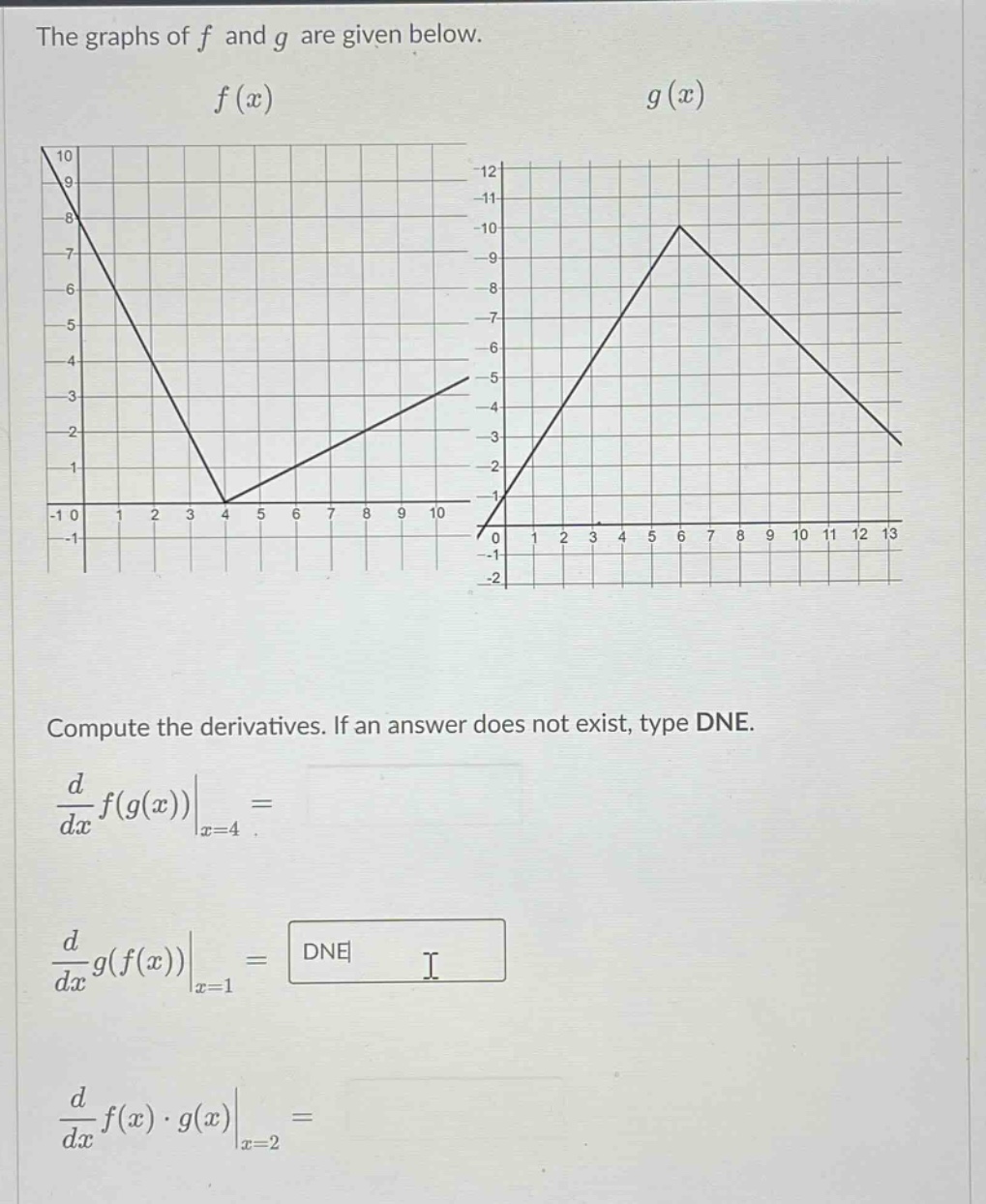
the graphs of f and g are given below. f(x) g(x) compute the derivatives. if an answer does not exist, type dne. d/dx f(g(x))|x = 4 = d/dx g(f(x))|x = 1 = dne d/dx f(x)·g(x)|x = 2 =
Answer
Explanation:
Step1: Recall the chain - rule
The chain - rule states that if $y = f(g(x))$, then $y^\prime=f^\prime(g(x))\cdot g^\prime(x)$. For $y = g(f(x))$, then $y^\prime = g^\prime(f(x))\cdot f^\prime(x)$. The product - rule states that if $y=f(x)\cdot g(x)$, then $y^\prime=f^\prime(x)g(x)+f(x)g^\prime(x)$.
Step2: Find $g(4)$ from the graph of $g(x)$
From the graph of $g(x)$, when $x = 4$, $g(4)=7$.
Step3: Find $g^\prime(4)$ from the graph of $g(x)$
The graph of $g(x)$ is a line for $3\lt x\lt6$. The slope of this line segment is $g^\prime(x)$. Using the two - point formula for slope $m=\frac{y_2 - y_1}{x_2 - x_1}$, with points $(3,5)$ and $(6,10)$ on the line segment of $g(x)$, $g^\prime(4)=\frac{10 - 5}{6 - 3}=\frac{5}{3}$.
Step4: Find $f^\prime(g(4))=f^\prime(7)$ from the graph of $f(x)$
The graph of $f(x)$ is a line for $4\lt x\lt10$. The slope of this line segment is $f^\prime(x)$. Using the two - point formula for slope with points $(4,0)$ and $(10,3)$, $f^\prime(7)=\frac{3 - 0}{10 - 4}=\frac{1}{2}$.
Step5: Calculate $\frac{d}{dx}f(g(x))|_{x = 4}$
By the chain - rule $\frac{d}{dx}f(g(x))|{x = 4}=f^\prime(g(4))\cdot g^\prime(4)$. Substituting $f^\prime(7)=\frac{1}{2}$ and $g^\prime(4)=\frac{5}{3}$, we get $\frac{d}{dx}f(g(x))|{x = 4}=\frac{1}{2}\times\frac{5}{3}=\frac{5}{6}$.
Step6: Find $f(1)$ from the graph of $f(x)$
From the graph of $f(x)$, when $x = 1$, $f(1)=6$.
Step7: Analyze $g^\prime(f(1)) = g^\prime(6)$
The graph of $g(x)$ has a corner at $x = 6$, so $g^\prime(6)$ does not exist. Thus, $\frac{d}{dx}g(f(x))|_{x = 1}$ does not exist (DNE).
Step8: Find $f(2)$ and $g(2)$ from the graphs
From the graph of $f(x)$, when $x = 2$, $f(2)=4$. From the graph of $g(x)$, when $x = 2$, $g(2)=3$.
Step9: Find $f^\prime(2)$ and $g^\prime(2)$ from the graphs
The graph of $f(x)$ is a line for $0\lt x\lt4$. The slope of this line segment is $f^\prime(x)$. Using the two - point formula for slope with points $(0,8)$ and $(4,0)$, $f^\prime(2)=\frac{0 - 8}{4 - 0}=- 2$. The graph of $g(x)$ is a line for $0\lt x\lt3$. The slope of this line segment is $g^\prime(x)$. Using the two - point formula for slope with points $(0,1)$ and $(3,5)$, $g^\prime(2)=\frac{5 - 1}{3 - 0}=\frac{4}{3}$.
Step10: Calculate $\frac{d}{dx}(f(x)g(x))|_{x = 2}$
By the product - rule $\frac{d}{dx}(f(x)g(x))|_{x = 2}=f^\prime(2)g(2)+f(2)g^\prime(2)$. Substituting $f^\prime(2)=-2$, $g(2)=3$, $f(2)=4$, and $g^\prime(2)=\frac{4}{3}$, we have $(-2)\times3+4\times\frac{4}{3}=-6+\frac{16}{3}=\frac{-18 + 16}{3}=-\frac{2}{3}$.
Answer:
$\frac{d}{dx}f(g(x))|{x = 4}=\frac{5}{6}$ $\frac{d}{dx}g(f(x))|{x = 1}=DNE$ $\frac{d}{dx}(f(x)g(x))|_{x = 2}=-\frac{2}{3}$