gravel is being dumped from a conveyor belt at a rate of 30 ft³/min, and its coarseness is such that it…
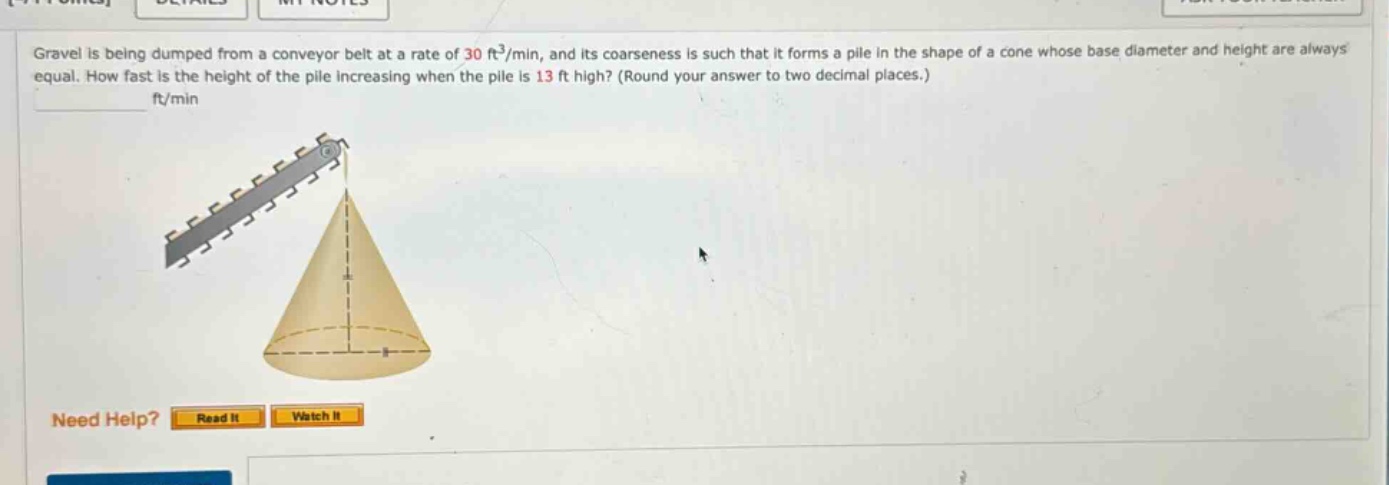
gravel is being dumped from a conveyor belt at a rate of 30 ft³/min, and its coarseness is such that it forms a pile in the shape of a cone whose base diameter and height are always equal. how fast is the height of the pile increasing when the pile is 13 ft high? (round your answer to two decimal places.) ft/min
Answer
Explanation:
Step1: Write volume formula for cone
The volume formula for a cone is $V=\frac{1}{3}\pi r^{2}h$. Given that $d = h$ (where $d$ is the diameter), and $d = 2r$, so $2r=h$ or $r=\frac{h}{2}$. Substitute $r=\frac{h}{2}$ into the volume formula: $V=\frac{1}{3}\pi(\frac{h}{2})^{2}h=\frac{1}{12}\pi h^{3}$.
Step2: Differentiate with respect to time $t$
Differentiate both sides of $V=\frac{1}{12}\pi h^{3}$ with respect to $t$ using the chain - rule. $\frac{dV}{dt}=\frac{1}{12}\pi\times3h^{2}\frac{dh}{dt}=\frac{\pi}{4}h^{2}\frac{dh}{dt}$.
Step3: Solve for $\frac{dh}{dt}$
We know that $\frac{dV}{dt}=30$ ft³/min and $h = 13$ ft. Rearrange the equation $\frac{dV}{dt}=\frac{\pi}{4}h^{2}\frac{dh}{dt}$ to solve for $\frac{dh}{dt}$. So $\frac{dh}{dt}=\frac{4\frac{dV}{dt}}{\pi h^{2}}$.
Step4: Substitute values
Substitute $\frac{dV}{dt}=30$ and $h = 13$ into the formula for $\frac{dh}{dt}$: $\frac{dh}{dt}=\frac{4\times30}{\pi\times13^{2}}=\frac{120}{\pi\times169}\approx0.23$ ft/min.
Answer:
$0.23$