ha2 - district assessment fig review\nname\ndirections: define the following words below:\n1) midline: \n2)…
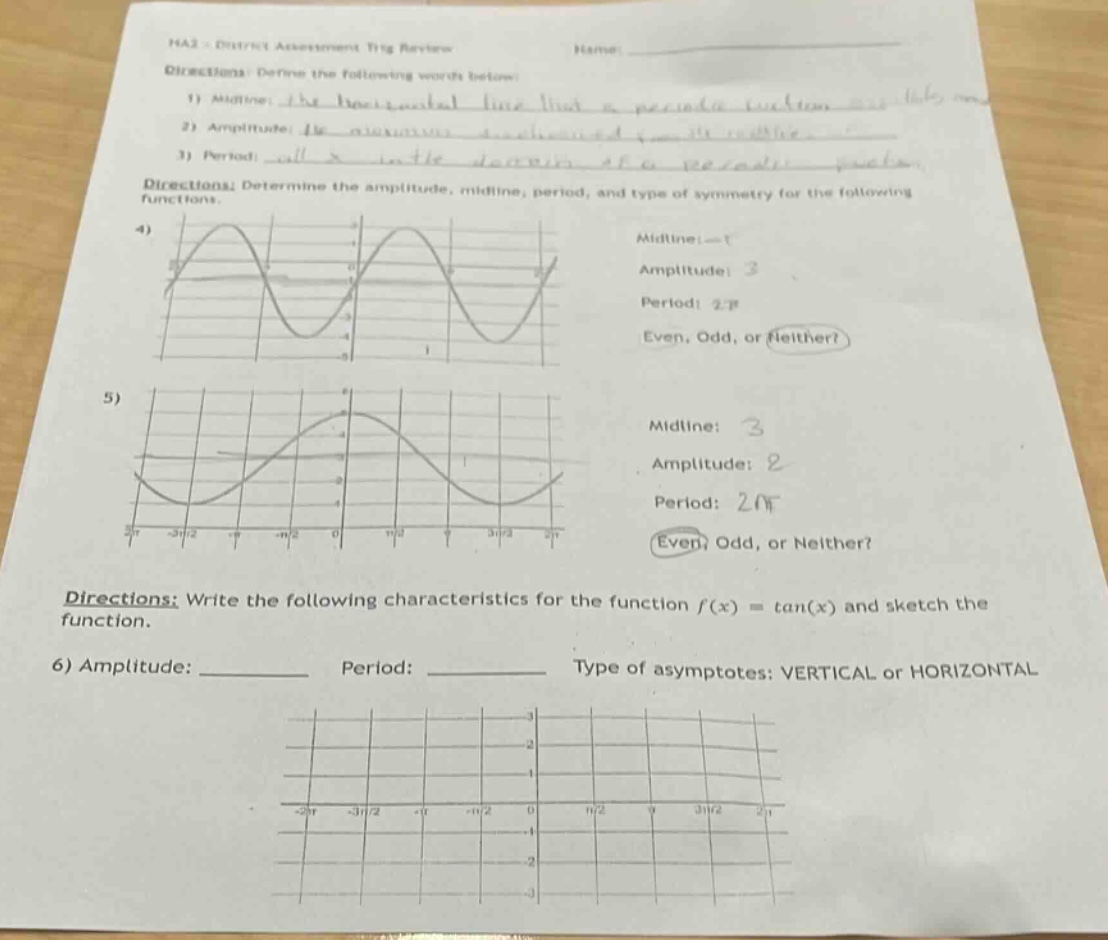
ha2 - district assessment fig review\nname\ndirections: define the following words below:\n1) midline: \n2) amplitude: \n3) period: \ndirections: determine the amplitude, midline, period, and type of symmetry for the following functions.\n4) midline: \namplitude: 3\nperiod: 2π\neven, odd, or neither?\n5) midline: 3\namplitude: 2\nperiod: 2π\neven, odd, or neither?\ndirections: write the following characteristics for the function f(x)=tan(x) and sketch the function.\n6) amplitude: \nperiod: \ntype of asymptotes: vertical or horizontal
Answer
Explanation:
Step1: Recall function - property definitions
For a periodic function (y = A\sin(Bx - C)+D) or (y = A\cos(Bx - C)+D), the mid - line is (y = D), the amplitude is (|A|), the period is (T=\frac{2\pi}{|B|}), and for symmetry, if (f(-x)=f(x)) it's even, if (f(-x)=-f(x)) it's odd. For (y = \tan(x)), we use its known properties.
Step2: Analyze problem 4
The mid - line is the horizontal line (y = 1), amplitude (A = 3), period (T = 2\pi). To check symmetry, assume the function is (y=f(x)). If we reflect the graph about the y - axis ((x = 0)), the graph does not match itself (not even), and if we rotate it 180 degrees about the origin, it does not match (not odd). So it's neither.
Step3: Analyze problem 5
The mid - line is (y = 3), amplitude (A = 2), period (T = 2\pi). Since the graph is symmetric about the y - axis ((f(-x)=f(x))), it is an even function.
Step4: Analyze (y=\tan(x))
The tangent function (y = \tan(x)=\frac{\sin(x)}{\cos(x)}) has no amplitude because its range is ((-\infty,\infty)). The period of (y=\tan(x)) is (\pi) (since (\tan(x+\pi)=\tan(x)) for all (x) in the domain of (\tan(x))). The function (y = \tan(x)) has vertical asymptotes at (x=\frac{\pi}{2}+n\pi), (n\in\mathbb{Z}) because (\cos(x) = 0) at these points and (\sin(x)\neq0) at these non - zero multiples of (\frac{\pi}{2}), and it has no horizontal asymptotes.
Answer:
- Midline: (y = 1), Amplitude: (3), Period: (2\pi), Even, Odd, or Neither: Neither
- Midline: (y = 3), Amplitude: (2), Period: (2\pi), Even, Odd, or Neither: Even
- Amplitude: None, Period: (\pi), Type of asymptotes: VERTICAL