what happens as x approaches zero from the positive direction? what happens as x approaches zero from the…
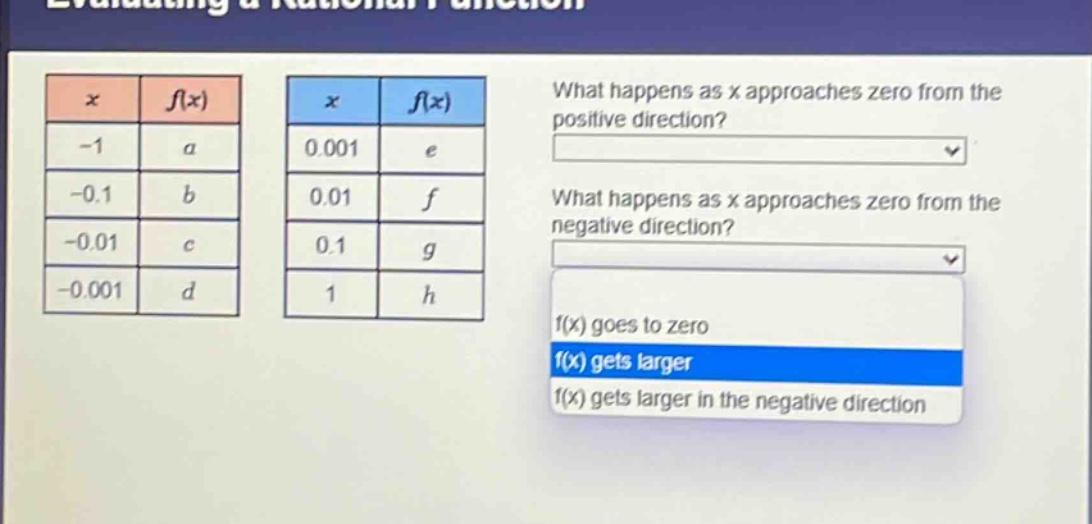
what happens as x approaches zero from the positive direction? what happens as x approaches zero from the negative direction? f(x) goes to zero f(x) gets larger f(x) gets larger in the negative direction
Answer
Explanation:
Step1: Analyze right - hand limit
As (x) approaches (0) from the positive direction ((x = 0.001,0.01,0.1)), if we assume (f(x)) is a rational function and based on the general behavior of rational functions near vertical asymptotes, when (x) gets closer to (0) from the positive side, we need to consider the form of the rational function. If the denominator has a factor of (x) and the numerator is non - zero at (x = 0), (f(x)) gets larger.
Step2: Analyze left - hand limit
As (x) approaches (0) from the negative direction ((x=- 0.001,-0.01,-0.1)), if the denominator has a factor of (x) and the numerator is non - zero at (x = 0), (f(x)) gets larger in the negative direction.
Answer:
What happens as (x) approaches zero from the positive direction: (f(x)) gets larger What happens as (x) approaches zero from the negative direction: (f(x)) gets larger in the negative direction