happyvilles population can be modeled using the function p(t)=24000e^0.21t, where p(t) is the population t…
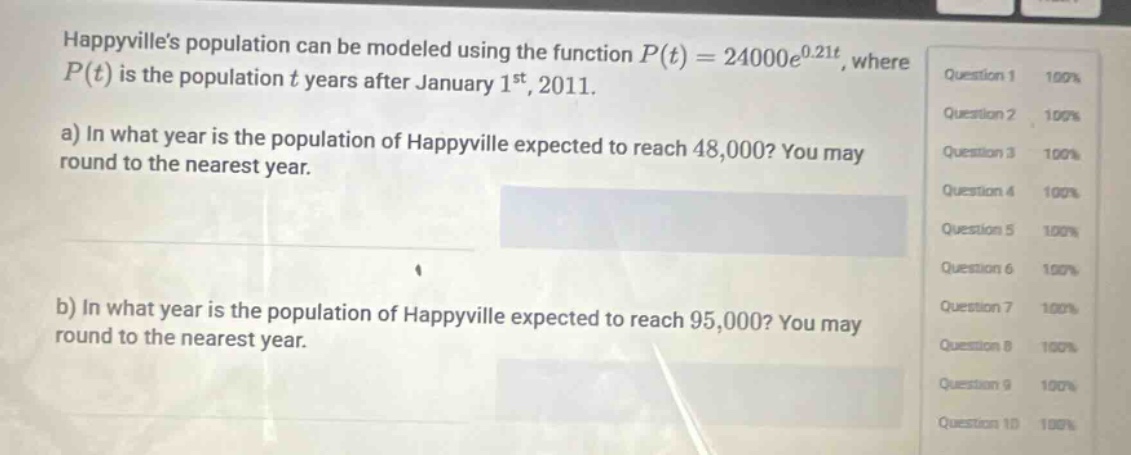
happyvilles population can be modeled using the function p(t)=24000e^0.21t, where p(t) is the population t years after january 1st, 2011. a) in what year is the population of happyville expected to reach 48,000? you may round to the nearest year. b) in what year is the population of happyville expected to reach 95,000? you may round to the nearest year.
Answer
Explanation:
Step1: Set up the equation for part a
Set $P(t)=48000$ in $P(t) = 24000e^{0.21t}$, so $48000=24000e^{0.21t}$.
Step2: Simplify the equation
Divide both sides by 24000: $\frac{48000}{24000}=e^{0.21t}$, which gives $2 = e^{0.21t}$.
Step3: Take the natural - logarithm of both sides
$\ln(2)=\ln(e^{0.21t})$. Since $\ln(e^{x}) = x$, we have $\ln(2)=0.21t$.
Step4: Solve for $t$
$t=\frac{\ln(2)}{0.21}\approx\frac{0.6931}{0.21}\approx 3.3$. Rounding to the nearest year, $t = 3$. The year is $2011 + 3=2014$.
Step5: Set up the equation for part b
Set $P(t)=95000$ in $P(t)=24000e^{0.21t}$, so $95000 = 24000e^{0.21t}$.
Step6: Simplify the equation
Divide both sides by 24000: $\frac{95000}{24000}=e^{0.21t}$, which gives $\frac{95}{24}=e^{0.21t}$.
Step7: Take the natural - logarithm of both sides
$\ln(\frac{95}{24})=\ln(e^{0.21t})$. Since $\ln(e^{x}) = x$, we have $\ln(\frac{95}{24})=0.21t$.
Step8: Solve for $t$
$t=\frac{\ln(\frac{95}{24})}{0.21}\approx\frac{\ln(3.9583)}{0.21}\approx\frac{1.376}{0.21}\approx 6.55$. Rounding to the nearest year, $t = 7$. The year is $2011+7 = 2018$.
Answer:
a) 2014 b) 2018