the height of the average wave, in feet, over t hours at sandy beach is modeled by the function g. g(t) =…
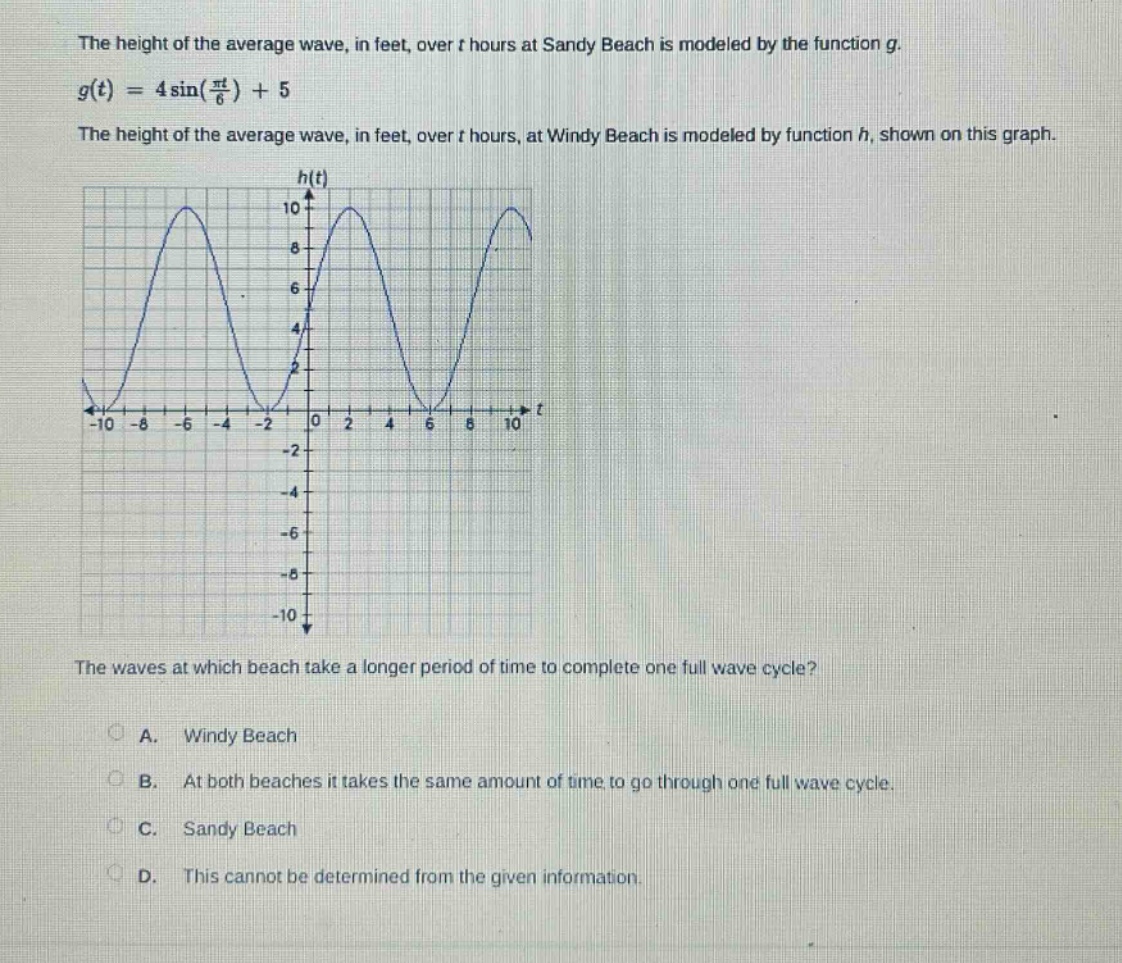
the height of the average wave, in feet, over t hours at sandy beach is modeled by the function g. g(t) = 4sin(πt/6) + 5 the height of the average wave, in feet, over t hours, at windy beach is modeled by function h, shown on this graph. the waves at which beach take a longer period of time to complete one full wave cycle? a. windy beach b. at both beaches it takes the same amount of time to go through one full wave cycle. c. sandy beach d. this cannot be determined from the given information.
Answer
Explanation:
Step1: Recall period formula for sine - function
For a sine - function of the form $y = A\sin(Bt - C)+D$, the period $T=\frac{2\pi}{|B|}$. For the function $g(t)=4\sin(\frac{\pi t}{6}) + 5$, $B=\frac{\pi}{6}$.
Step2: Calculate period of $g(t)$
Using the formula $T=\frac{2\pi}{|B|}$, we substitute $B = \frac{\pi}{6}$ into it. So $T_g=\frac{2\pi}{\frac{\pi}{6}}=12$ hours.
Step3: Determine period of $h(t)$ from the graph
From the graph of $h(t)$, we can see that one full - wave cycle occurs from $t = 0$ to $t = 12$ hours. So $T_h = 12$ hours.
Answer:
B. At both beaches it takes the same amount of time to go through one full wave cycle.