3. the height, in feet, of a squirrel running up and down a tree is a function of time, in seconds. here are…
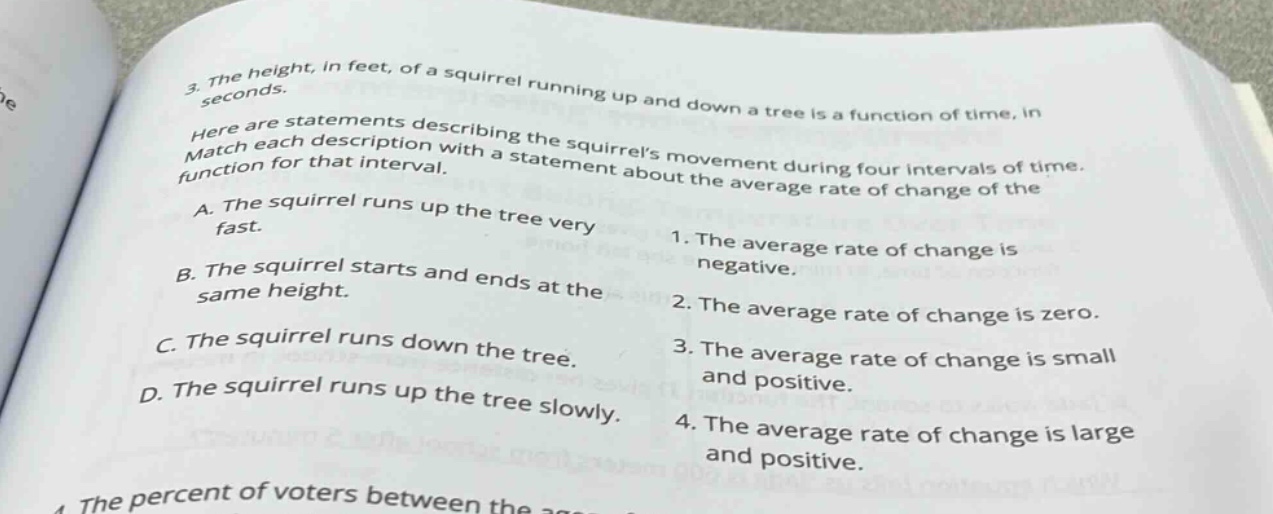
3. the height, in feet, of a squirrel running up and down a tree is a function of time, in seconds. here are statements describing the squirrels movement during four intervals of time. match each description with a statement about the average rate of change of the function for that interval. a. the squirrel runs up the tree very fast. b. the squirrel starts and ends at the same height. c. the squirrel runs down the tree. d. the squirrel runs up the tree slowly. 1. the average rate of change is negative. 2. the average rate of change is zero. 3. the average rate of change is small and positive. 4. the average rate of change is large and positive.
Answer
Explanation:
Step1: Understand average - rate - of - change concept
The average rate of change of a function (height as a function of time here) is $\frac{\Delta y}{\Delta x}=\frac{y_2 - y_1}{x_2 - x_1}$. Positive means height is increasing, negative means height is decreasing, zero means no net - change in height, and the magnitude represents the speed of change.
Step2: Match A
When the squirrel runs up the tree very fast, the height increases rapidly. So the average rate of change is large and positive. A matches 4.
Step3: Match B
If the squirrel starts and ends at the same height, then $y_2=y_1$, so $\frac{y_2 - y_1}{x_2 - x_1}=0$. B matches 2.
Step4: Match C
When the squirrel runs down the tree, the height is decreasing. So the average rate of change is negative. C matches 1.
Step5: Match D
When the squirrel runs up the tree slowly, the height is increasing but at a slow pace. So the average rate of change is small and positive. D matches 3.
Answer:
A. 4 B. 2 C. 1 D. 3