the height, h, in feet of the tip of the hour hand of a wall clock varies from 9 feet to 10 feet. which of…
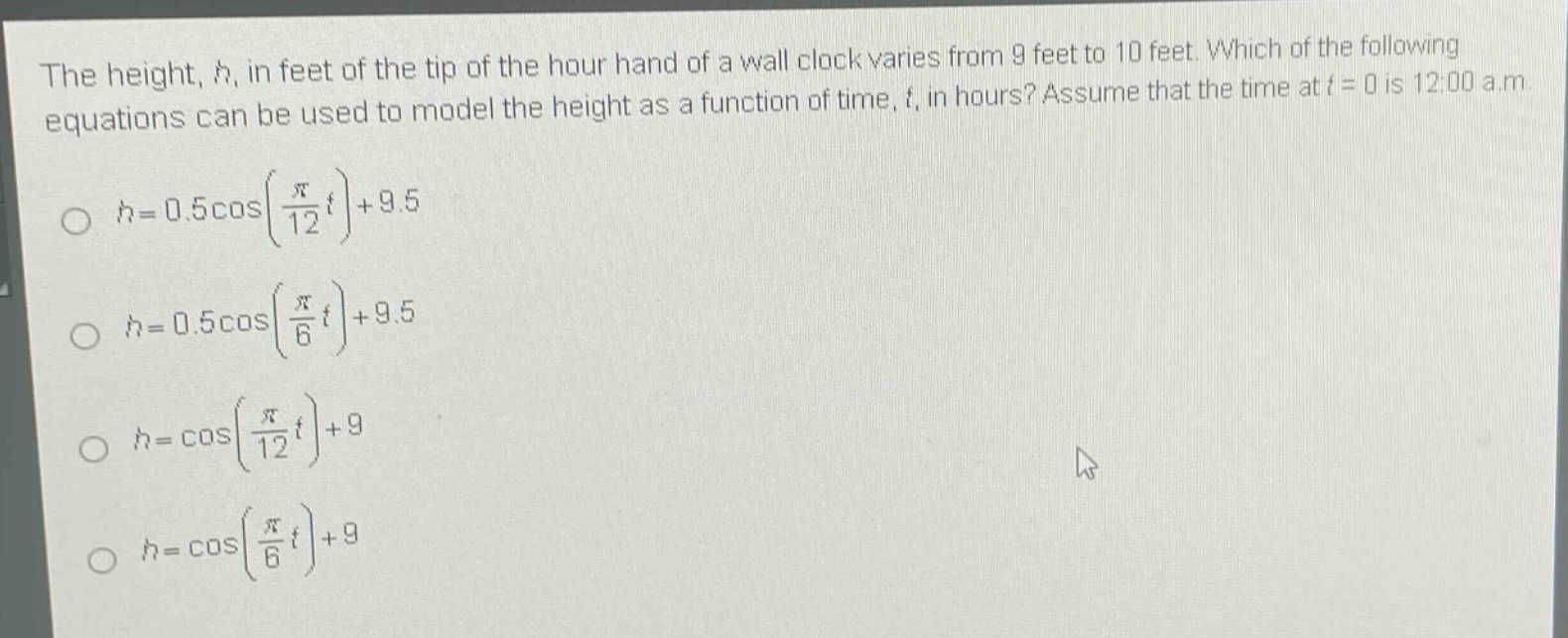
the height, h, in feet of the tip of the hour hand of a wall clock varies from 9 feet to 10 feet. which of the following equations can be used to model the height as a function of time, t, in hours? assume that the time at t = 0 is 12:00 a.m.\n\n$h = 0.5cosleft(\frac{pi}{12}t\right)+9.5$\n\n$h = 0.5cosleft(\frac{pi}{6}t\right)+9.5$\n\n$h=cosleft(\frac{pi}{12}t\right)+9$\n\n$h=cosleft(\frac{pi}{6}t\right)+9$
Answer
Explanation:
Step1: Determine the amplitude
The height varies from 9 feet to 10 feet. The amplitude $A$ of a cosine - type function $y = A\cos(Bt)+C$ is given by $A=\frac{\text{max}-\text{min}}{2}$. Here, $\text{max} = 10$ and $\text{min}=9$, so $A=\frac{10 - 9}{2}=0.5$.
Step2: Determine the vertical shift
The vertical shift $C$ is given by $C=\frac{\text{max}+\text{min}}{2}$. So $C=\frac{10 + 9}{2}=9.5$.
Step3: Determine the period
The hour - hand of a clock has a period of 12 hours. For a cosine function $y = A\cos(Bt)+C$, the period $T=\frac{2\pi}{B}$. Since $T = 12$, we have $12=\frac{2\pi}{B}$, and solving for $B$ gives $B=\frac{\pi}{6}$. The general form of the cosine function for the height $h$ as a function of time $t$ is $h = A\cos(Bt)+C$, substituting $A = 0.5$, $B=\frac{\pi}{6}$ and $C = 9.5$ we get $h=0.5\cos\left(\frac{\pi}{6}t\right)+9.5$.
Answer:
$h = 0.5\cos\left(\frac{\pi}{6}t\right)+9.5$