the height of a golf - ball in meters can be described by the equation (h=-4.9t^{2}+23.5t), where (t) is the…
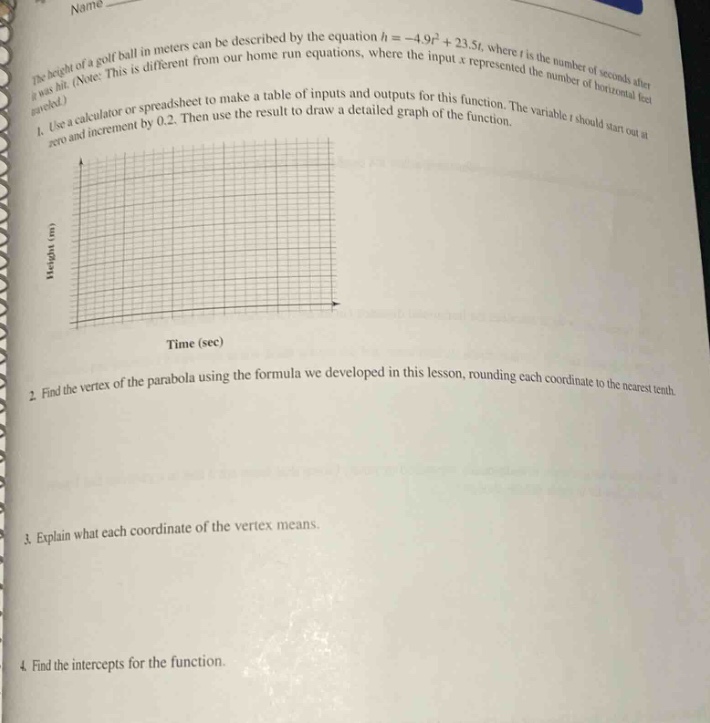
the height of a golf - ball in meters can be described by the equation (h=-4.9t^{2}+23.5t), where (t) is the number of seconds after it was hit. (note: this is different from our home run equations, where the input (x) represented the number of horizontal feet traveled.)\n1. use a calculator or spreadsheet to make a table of inputs and outputs for this function. the variable (t) should start out at zero and increment by 0.2. then use the result to draw a detailed graph of the function.\n2. find the vertex of the parabola using the formula we developed in this lesson, rounding each coordinate to the nearest tenth.\n3. explain what each coordinate of the vertex means.\n4. find the intercepts for the function.
Answer
Explanation:
Step1: Create a table of values
We are given the function $h = - 4.9t^{2}+23.5t$. Let $t$ start at $0$ and increment by $0.2$.
| $t$ | $h=-4.9t^{2}+23.5t$ |
|---|---|
| $0$ | $h=-4.9(0)^{2}+23.5(0)=0$ |
| $0.2$ | $h=-4.9(0.2)^{2}+23.5(0.2)=-4.9\times0.04 + 4.7=4.7 - 0.196 = 4.504$ |
| $0.4$ | $h=-4.9(0.4)^{2}+23.5(0.4)=-4.9\times0.16+9.4 = 9.4 - 0.784=8.616$ |
| $\cdots$ | $\cdots$ |
Step2: Find the vertex of the parabola
For a quadratic function of the form $y = ax^{2}+bx + c$, the $t$-coordinate of the vertex is given by $t=-\frac{b}{2a}$. In the function $h=-4.9t^{2}+23.5t$, $a=-4.9$ and $b = 23.5$. $t=-\frac{23.5}{2\times(-4.9)}=\frac{23.5}{9.8}\approx2.4$ Substitute $t = 2.4$ into the function $h=-4.9(2.4)^{2}+23.5(2.4)=-4.9\times5.76+56.4=-28.224 + 56.4 = 28.2$ (rounded to the nearest tenth). So the vertex is $(2.4,28.2)$.
Step3: Interpret the vertex coordinates
The $t -$coordinate ($t = 2.4$) represents the time (in seconds) at which the golf - ball reaches its maximum height. The $h -$coordinate ($h = 28.2$) represents the maximum height (in meters) that the golf - ball reaches.
Step4: Find the intercepts
y - intercept
Set $t = 0$ in the function $h=-4.9t^{2}+23.5t$. Then $h=-4.9(0)^{2}+23.5(0)=0$. So the $y$-intercept is $(0,0)$.
x - intercepts
Set $h = 0$ in the function $0=-4.9t^{2}+23.5t$. Factor out $t$: $t(-4.9t + 23.5)=0$. This gives two solutions: $t = 0$ or $-4.9t+23.5 = 0$. Solving $-4.9t+23.5 = 0$ for $t$: $-4.9t=-23.5$, so $t=\frac{23.5}{4.9}\approx4.8$. The $x$-intercepts are $(0,0)$ and $(4.8,0)$.
Answer:
- Table of values can be created as shown above and graph can be plotted using those points.
- Vertex: $(2.4,28.2)$
- $t = 2.4$ is time of max - height, $h = 28.2$ is max - height.
- $y$-intercept: $(0,0)$; $x$-intercepts: $(0,0)$ and $(4.8,0)$