the height of an object at time $tgeq1$ is given by $h(t)=t^{2}-\frac{16}{t}+15$. what is the velocity of…
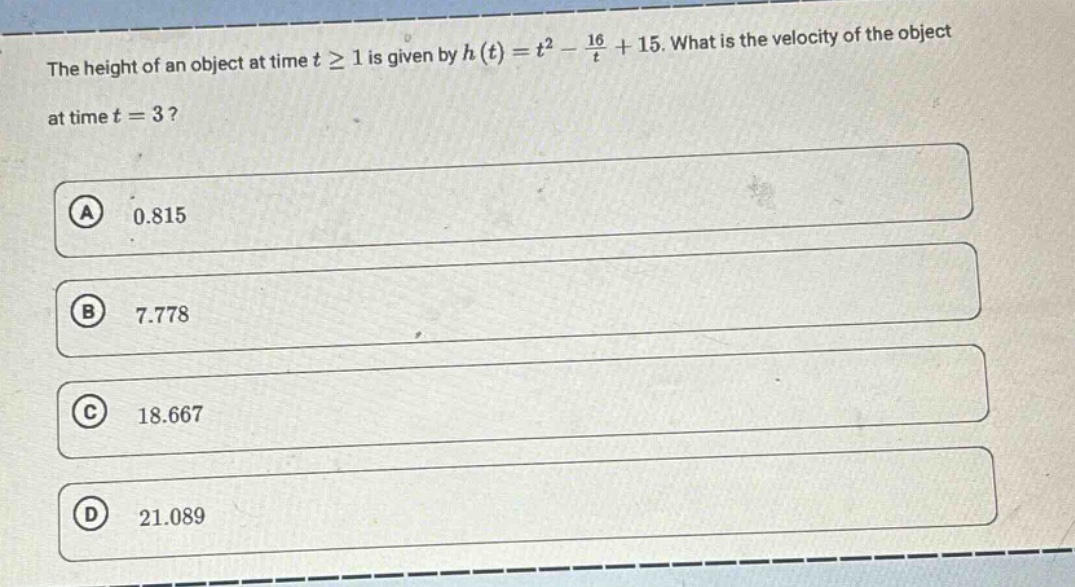
the height of an object at time $tgeq1$ is given by $h(t)=t^{2}-\frac{16}{t}+15$. what is the velocity of the object at time $t = 3$?\n(a) 0.815\n(b) 7.778\n(c) 18.667\n(d) 21.089
Answer
Explanation:
Step1: Recall velocity - derivative relation
Velocity $v(t)$ is the derivative of height $h(t)$. Given $h(t)=t^{2}-\frac{16}{t}+15=t^{2}-16t^{- 1}+15$.
Step2: Differentiate $h(t)$
Using the power - rule $\frac{d}{dt}(t^{n})=nt^{n - 1}$, we have $v(t)=\frac{d}{dt}(t^{2}-16t^{-1}+15)=2t + 16t^{-2}=2t+\frac{16}{t^{2}}$.
Step3: Evaluate $v(t)$ at $t = 3$
Substitute $t = 3$ into $v(t)$: $v(3)=2\times3+\frac{16}{3^{2}}=6+\frac{16}{9}=\frac{54 + 16}{9}=\frac{70}{9}\approx7.778$.
Answer:
B. 7.778