the height of a single car on a ferris wheel is modeled by a cosine function. the car completes 4 whole…
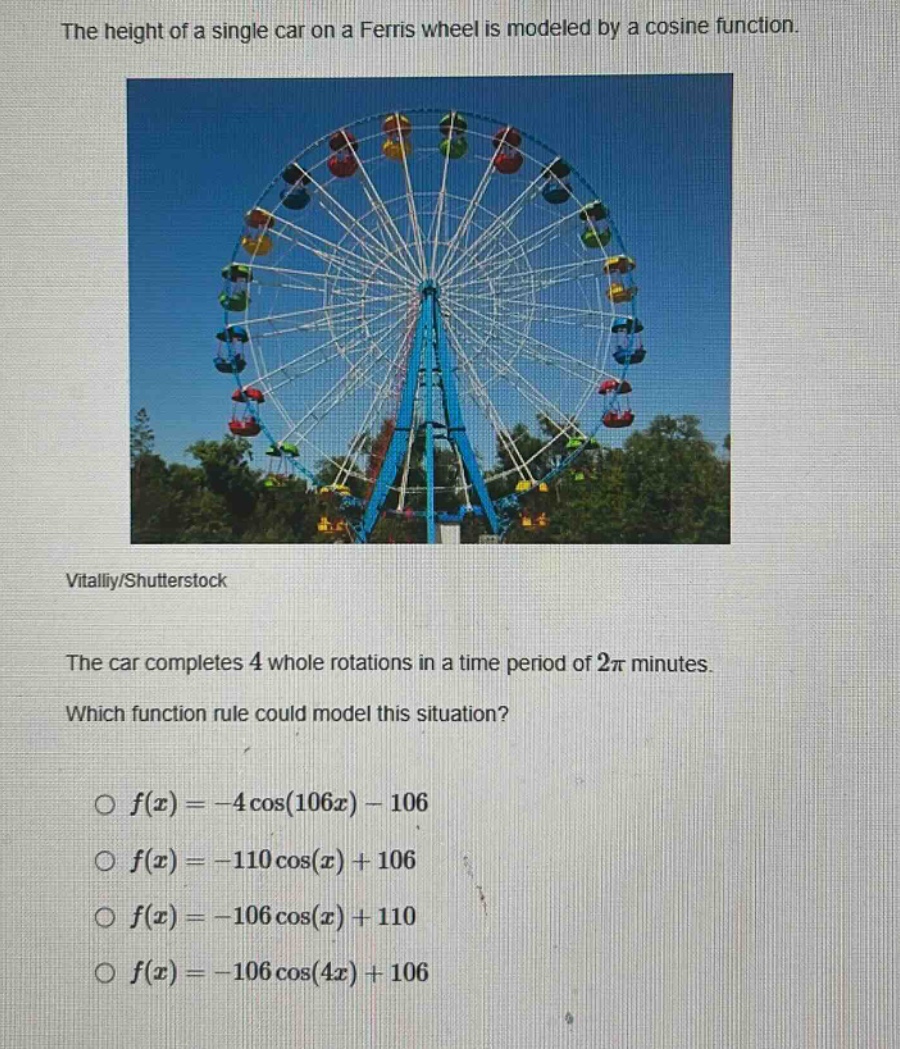
the height of a single car on a ferris wheel is modeled by a cosine function. the car completes 4 whole rotations in a time period of 2π minutes. which function rule could model this situation? o f(x)= - 4cos(106x)-106 o f(x)= - 110cos(x)+106 o f(x)= - 106cos(x)+110 o f(x)= - 106cos(4x)+106
Answer
Explanation:
Step1: Recall the general form of a cosine - function
The general form of a cosine function is $y = A\cos(Bx - C)+D$, where $|A|$ is the amplitude, the period $T=\frac{2\pi}{B}$, $C$ is the phase - shift, and $D$ is the vertical shift.
Step2: Calculate the value of $B$
We know that the car completes 4 whole rotations in a time period of $2\pi$ minutes. The period $T$ of one rotation is $\frac{2\pi}{4}=\frac{\pi}{2}$ minutes. Using the formula $T = \frac{2\pi}{B}$, and substituting $T=\frac{\pi}{2}$, we get $\frac{\pi}{2}=\frac{2\pi}{B}$. Solving for $B$: Cross - multiply: $\pi B = 4\pi$, so $B = 4$.
Step3: Analyze the options
We are looking for a function of the form $y=A\cos(4x)+D$.
- Option 1: $f(x)=-4\cos(106x)-106$ has $B = 106$, which is incorrect.
- Option 2: $f(x)=-110\cos(x)+106$ has $B = 1$, which is incorrect.
- Option 3: $f(x)=-106\cos(x)+110$ has $B = 1$, which is incorrect.
- Option 4: $f(x)=-106\cos(4x)+106$ has $B = 4$, which is correct.
Answer:
$f(x)=-106\cos(4x)+106$