his question has several parts that must be completed sequentially. if you skip a part of th part. consider…
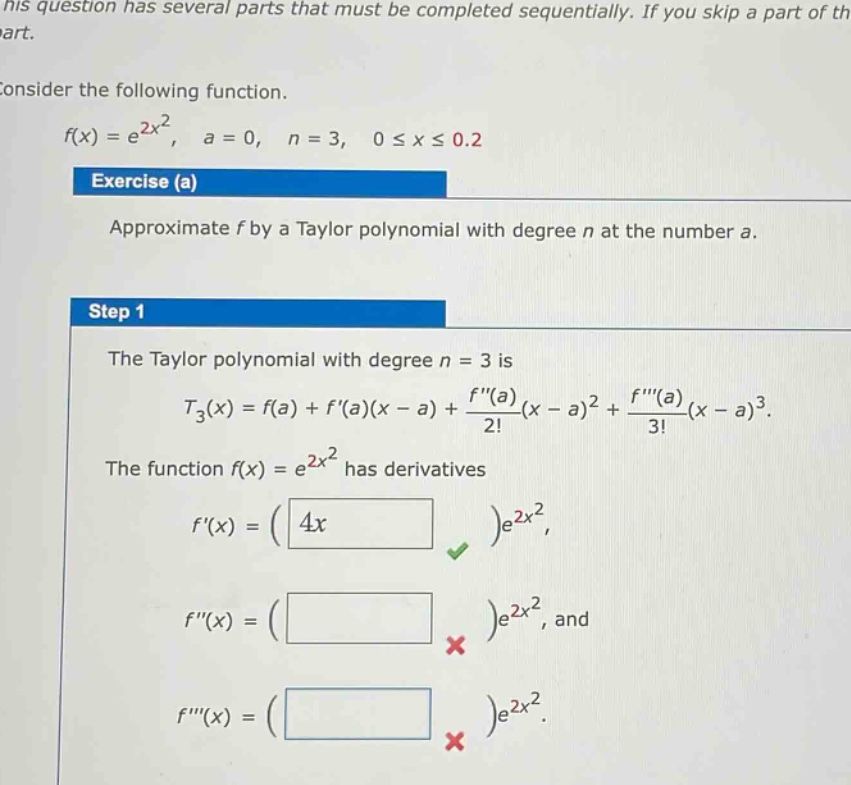
his question has several parts that must be completed sequentially. if you skip a part of th part. consider the following function. f(x)=e^{2x^{2}}, a = 0, n = 3, 0≤x≤0.2 exercise (a) approximate f by a taylor polynomial with degree n at the number a. step 1 the taylor polynomial with degree n = 3 is t_{3}(x)=f(a)+f(a)(x - a)+\\frac{f(a)}{2!}(x - a)^{2}+\\frac{f(a)}{3!}(x - a)^{3}. the function f(x)=e^{2x^{2}} has derivatives f(x)=(4x)e^{2x^{2}}, f(x)=( )e^{2x^{2}}, and f(x)=( )e^{2x^{2}}.
Answer
Explanation:
Step1: Find the second - derivative
Use the product rule $(uv)^\prime = u^\prime v+uv^\prime$. Let $u = 4x$ and $v = e^{2x^{2}}$. Then $u^\prime=4$ and $v^\prime = 4xe^{2x^{2}}$. So $f^{\prime\prime}(x)=(4 + 16x^{2})e^{2x^{2}}$.
Step2: Find the third - derivative
Again use the product rule. Let $u = 4 + 16x^{2}$ and $v = e^{2x^{2}}$. Then $u^\prime=32x$ and $v^\prime = 4xe^{2x^{2}}$. So $f^{\prime\prime\prime}(x)=(32x+(4 + 16x^{2})\times4x)e^{2x^{2}}=(32x + 16x+64x^{3})e^{2x^{2}}=(48x + 64x^{3})e^{2x^{2}}$.
Answer:
$f^{\prime\prime}(x)=(4 + 16x^{2})e^{2x^{2}}$, $f^{\prime\prime\prime}(x)=(48x + 64x^{3})e^{2x^{2}}$