6. a hive contains 35 hundred bees at time t = 0. during the time interval 0 ≤ t ≤ 4 hours, bees enter the…
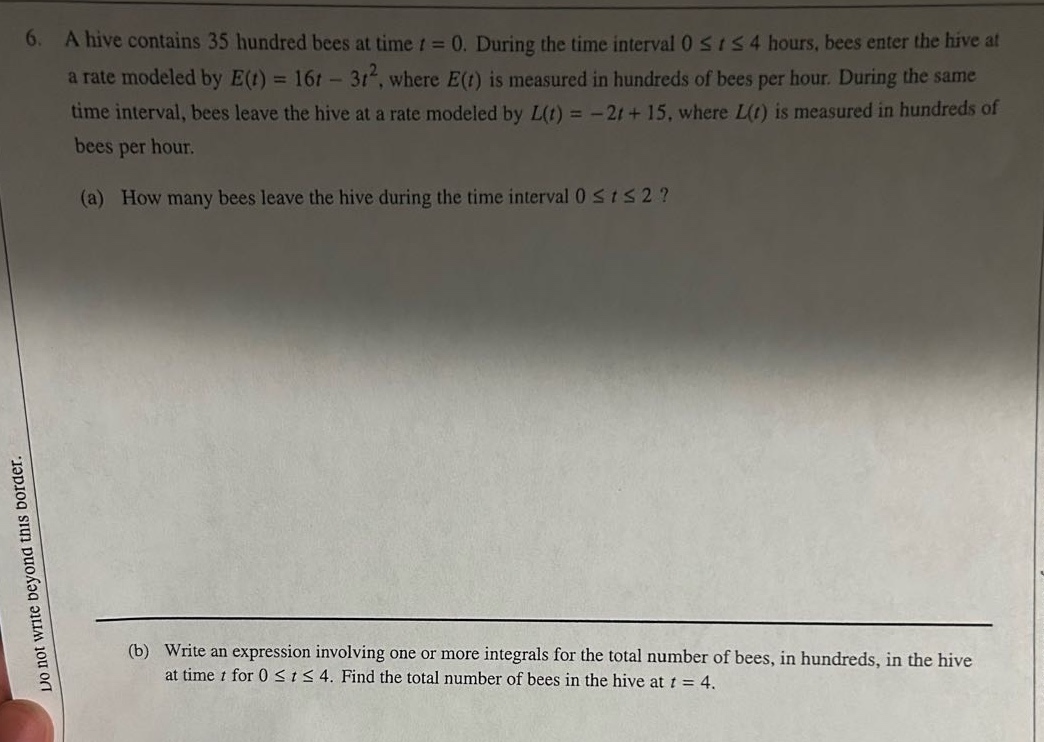
6. a hive contains 35 hundred bees at time t = 0. during the time interval 0 ≤ t ≤ 4 hours, bees enter the hive at a rate modeled by e(t)=16t - 3t², where e(t) is measured in hundreds of bees per hour. during the same time interval, bees leave the hive at a rate modeled by l(t)= - 2t + 15, where l(t) is measured in hundreds of bees per hour. (a) how many bees leave the hive during the time interval 0 ≤ t ≤ 2? (b) write an expression involving one or more integrals for the total number of bees, in hundreds, in the hive at time t for 0 ≤ t ≤ 4. find the total number of bees in the hive at t = 4.
Answer
Explanation:
Step1: Recall the definite - integral formula for total change
The total number of bees that leave the hive from (t = 0) to (t = 2) is given by the definite integral (\int_{a}^{b}L(t)dt), where (a = 0), (b = 2), and (L(t)=-2t + 15).
Step2: Calculate the definite integral
[ \begin{align*} \int_{0}^{2}(-2t + 15)dt&=\int_{0}^{2}-2tdt+\int_{0}^{2}15dt\ &=-2\int_{0}^{2}tdt + 15\int_{0}^{2}dt \end{align*} ] Using the power - rule for integration (\int x^n dx=\frac{x^{n + 1}}{n+1}+C(n\neq - 1)), we have (-2\times\frac{t^{2}}{2}\big|{0}^{2}+15t\big|{0}^{2}). [ \begin{align*} &=-(t^{2})\big|{0}^{2}+15t\big|{0}^{2}\ &=-(2^{2}-0^{2})+15(2 - 0)\ &=-4 + 30\ &=26 \end{align*} ]
Step3: For part (b), find the expression for the number of bees in the hive
The initial number of bees is (N(0)=35). The net change in the number of bees from (t = 0) to (t) is (\int_{0}^{t}(E(s)-L(s))ds), where (E(s)=16s-3s^{2}) and (L(s)=-2s + 15). So the number of bees (N(t)) in hundreds at time (t) for (0\leq t\leq4) is (N(t)=35+\int_{0}^{t}((16s-3s^{2})-(-2s + 15))ds=35+\int_{0}^{t}(18s-3s^{2}-15)ds).
Step4: Calculate (N(4))
[ \begin{align*} N(4)&=35+\int_{0}^{4}(18s-3s^{2}-15)ds\ &=35+\left(18\times\frac{s^{2}}{2}-3\times\frac{s^{3}}{3}-15s\right)\big|{0}^{4}\ &=35+(9s^{2}-s^{3}-15s)\big|{0}^{4}\ &=35+(9\times4^{2}-4^{3}-15\times4)\ &=35+(9\times16 - 64-60)\ &=35+(144 - 64 - 60)\ &=35 + 20\ &=55 \end{align*} ]
Answer:
(a) 2600 bees (b) The expression for the number of bees in the hive at time (t) is (N(t)=35+\int_{0}^{t}(18s - 3s^{2}-15)ds). The number of bees in the hive at (t = 4) is 5500 bees.