4. for x≥0, the horizontal line y = 2 is an asymptote for the graph of the function f. which of the…
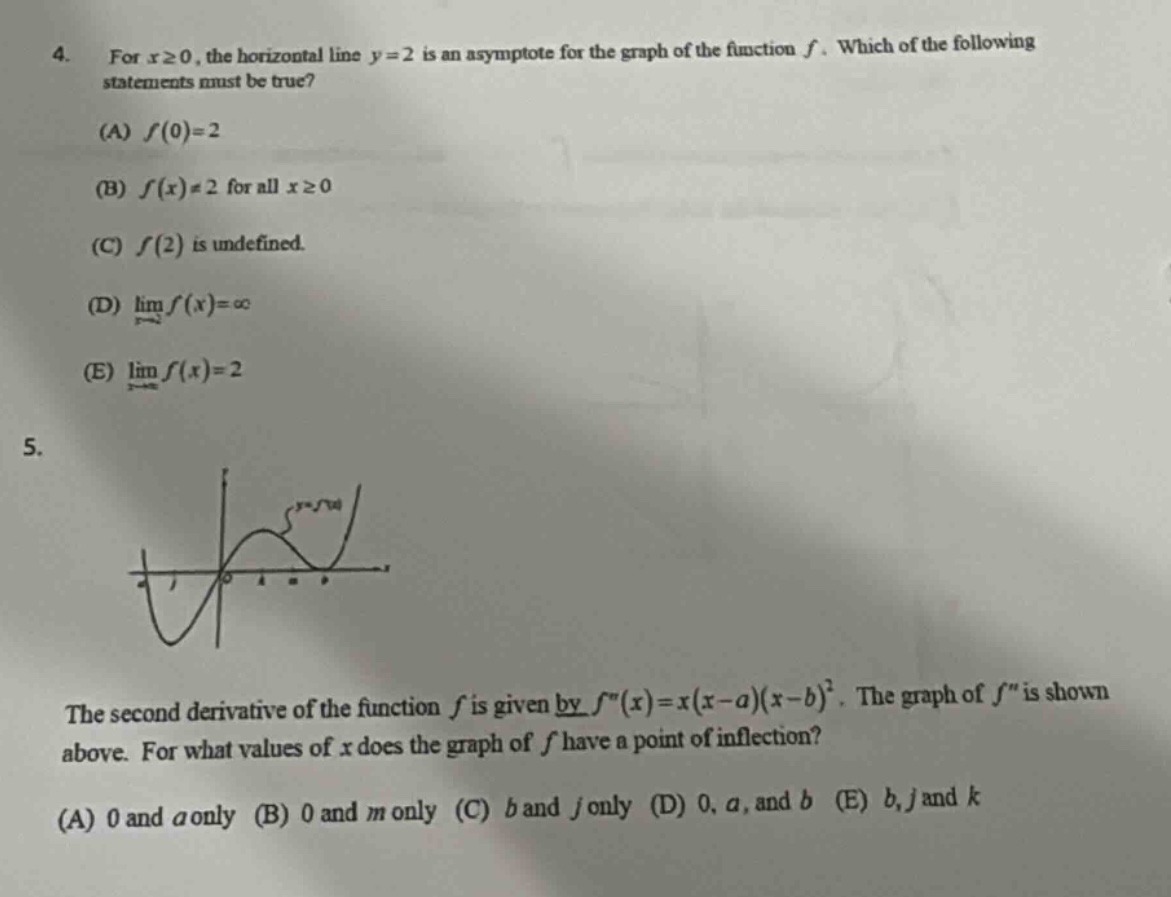
4. for x≥0, the horizontal line y = 2 is an asymptote for the graph of the function f. which of the following statements must be true? (a) f(0)=2 (b) f(x)≠2 for all x≥0 (c) f(2) is undefined. (d) lim f(x)=∞ (e) lim f(x)=2 5. the second derivative of the function f is given by f(x)=x(x - a)(x - b)^2. the graph of f is shown above. for what values of x does the graph of f have a point of inflection? (a) 0 and a only (b) 0 and m only (c) b and j only (d) 0, a, and b (e) b, j and k
Answer
Explanation:
Step1: Recall horizontal - asymptote definition
A horizontal line (y = L) is a horizontal asymptote of the function (y = f(x)) if (\lim_{x\rightarrow\infty}f(x)=L) or (\lim_{x\rightarrow-\infty}f(x)=L). Given for (x\geq0), (y = 2) is a horizontal asymptote of (y = f(x)), so (\lim_{x\rightarrow\infty}f(x)=2).
Step2: Analyze each option
- Option (A): Just because (y = 2) is an asymptote doesn't mean (f(0)=2). The function value at (x = 0) has no relation to the asymptote value.
- Option (B): The function can cross its horizontal asymptote. So (f(x)) can be equal to (2) for some (x\geq0).
- Option (C): There is no information to suggest that (f(2)) is undefined.
- Option (D): (\lim_{x\rightarrow\infty}f(x)\neq\infty) since (y = 2) is a horizontal asymptote.
- Option (E): Since (y = 2) is a horizontal asymptote for (x\geq0), (\lim_{x\rightarrow\infty}f(x)=2).
Step3: Recall inflection - point definition
A point of inflection of the graph of (y = f(x)) occurs where (f''(x)) changes sign. Given (f''(x)=x(x - a)(x - b)^2). The roots of (f''(x)) are (x = 0), (x=a) and (x = b). Since ((x - b)^2\geq0) for all (x), the sign of (f''(x)) changes at (x = 0) and (x=a) (because the factor ((x - b)^2) does not change the sign at (x = b) as it is a squared - factor).
Answer:
- E. (\lim_{x\rightarrow\infty}f(x)=2)
- A. 0 and (a) only