a hot - air balloon is 190 ft above the ground when a motorcycle (traveling in a straight line on a…
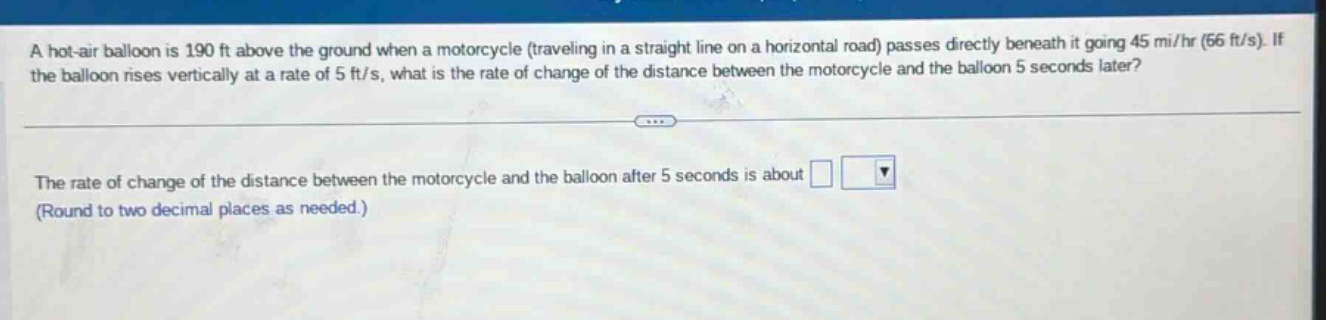
a hot - air balloon is 190 ft above the ground when a motorcycle (traveling in a straight line on a horizontal road) passes directly beneath it going 45 mi/hr (66 ft/s). if the balloon rises vertically at a rate of 5 ft/s, what is the rate of change of the distance between the motorcycle and the balloon 5 seconds later? the rate of change of the distance between the motorcycle and the balloon after 5 seconds is about (round to two decimal places as needed.)
Answer
Explanation:
Step1: Set up variables
Let $x$ be the horizontal distance of the motorcycle from the initial - position (beneath the balloon), $y$ be the vertical height of the balloon above the ground, and $z$ be the distance between the motorcycle and the balloon. By the Pythagorean theorem, $z^{2}=x^{2}+y^{2}$.
Step2: Find $x$ and $y$ at $t = 5$ seconds
The motorcycle's speed $v_{x}=66$ ft/s, so $x = 66t$. When $t = 5$, $x=66\times5 = 330$ ft. The balloon's initial height $y_{0}=190$ ft and its upward - speed $v_{y}=5$ ft/s. So $y=y_{0}+5t$. When $t = 5$, $y=190 + 5\times5=190 + 25=215$ ft.
Step3: Calculate $z$ at $t = 5$ seconds
Using $z^{2}=x^{2}+y^{2}$, when $x = 330$ and $y = 215$, $z=\sqrt{330^{2}+215^{2}}=\sqrt{108900 + 46225}=\sqrt{155125}\approx393.86$ ft.
Step4: Differentiate $z^{2}=x^{2}+y^{2}$ with respect to time $t$
Differentiating both sides of $z^{2}=x^{2}+y^{2}$ with respect to $t$ gives $2z\frac{dz}{dt}=2x\frac{dx}{dt}+2y\frac{dy}{dt}$, or $z\frac{dz}{dt}=x\frac{dx}{dt}+y\frac{dy}{dt}$. We know that $\frac{dx}{dt}=66$ ft/s and $\frac{dy}{dt}=5$ ft/s.
Step5: Solve for $\frac{dz}{dt}$
Substitute $x = 330$, $y = 215$, $z\approx393.86$, $\frac{dx}{dt}=66$, and $\frac{dy}{dt}=5$ into $z\frac{dz}{dt}=x\frac{dx}{dt}+y\frac{dy}{dt}$. $393.86\frac{dz}{dt}=330\times66+215\times5$ $393.86\frac{dz}{dt}=21780 + 1075$ $393.86\frac{dz}{dt}=22855$ $\frac{dz}{dt}=\frac{22855}{393.86}\approx58.03$ ft/s
Answer:
$58.03$