the hours of daylight in glasgow, scotland, can be modeled by the function f given by f(d)=5.3…
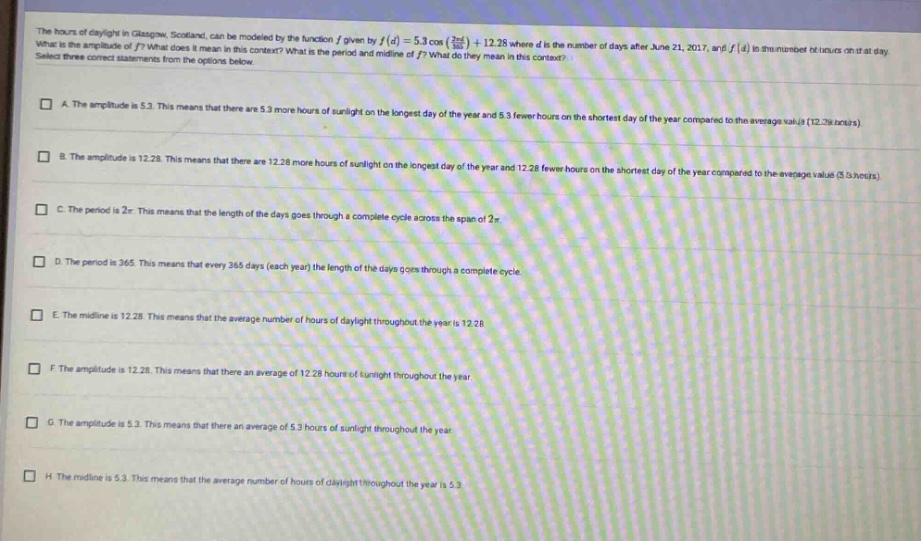
the hours of daylight in glasgow, scotland, can be modeled by the function f given by f(d)=5.3 cos(2πd/365)+12.28 where d is the number of days after june 21, 2017, and f(d) is the number of hours on that day. what is the amplitude of f? what does it mean in this context? what is the period and mid - line of f? what do they mean in this context? select three correct statements from the options below. a. the amplitude is 5.3. this means that there are 5.3 more hours of sunlight on the longest day of the year and 5.3 fewer hours on the shortest day of the year compared to the average value (12.28 hours). b. the amplitude is 12.28. this means that there are 12.28 more hours of sunlight on the longest day of the year and 12.28 fewer hours on the shortest day of the year compared to the average value (5.3 hours). c. the period is 2π. this means that the length of the days goes through a complete cycle across the span of 2π. d. the period is 365. this means that every 365 days (each year) the length of the days goes through a complete cycle. e. the mid - line is 12.28. this means that the average number of hours of daylight throughout the year is 12.28. f. the amplitude is 12.28. this means that there an average of 12.28 hours of sunlight throughout the year. g. the amplitude is 5.3. this means that there an average of 5.3 hours of sunlight throughout the year. h. the mid - line is 5.3. this means that the average number of hours of daylight throughout the year is 5.3.
Answer
Explanation:
Step1: Recall amplitude - formula and meaning
For a function of the form $y = A\cos(Bx - C)+D$, the amplitude is $|A|$. In $f(d)=5.3\cos(\frac{2\pi d}{365}) + 12.28$, $A = 5.3$. The amplitude represents the maximum deviation from the average value. So, there are 5.3 more hours of sunlight on the longest day and 5.3 fewer hours on the shortest day compared to the average value (12.28 hours).
Step2: Recall period - formula and meaning
The period of the function $y = A\cos(Bx - C)+D$ is $T=\frac{2\pi}{|B|}$. Here, $B=\frac{2\pi}{365}$, so $T = 365$. This means that every 365 days (each year), the length of the days goes through a complete cycle.
Step3: Recall mid - line formula and meaning
The mid - line of the function $y = A\cos(Bx - C)+D$ is $y = D$. In $f(d)=5.3\cos(\frac{2\pi d}{365})+12.28$, $D = 12.28$. This means that the average number of hours of daylight throughout the year is 12.28.
Answer:
A. The amplitude is 5.3. This means that there are 5.3 more hours of sunlight on the longest day of the year and 5.3 fewer hours on the shortest day of the year compared to the average value (12.28 hours). D. The period is 365. This means that every 365 days (each year) the length of the days goes through a complete cycle. E. The midline is 12.28. This means that the average number of hours of daylight throughout the year is 12.28.