the hyperbolic sine function is defined by sinh(x)=(e^x - e^(-x))/2. (a) sketch the graphs of the functions…
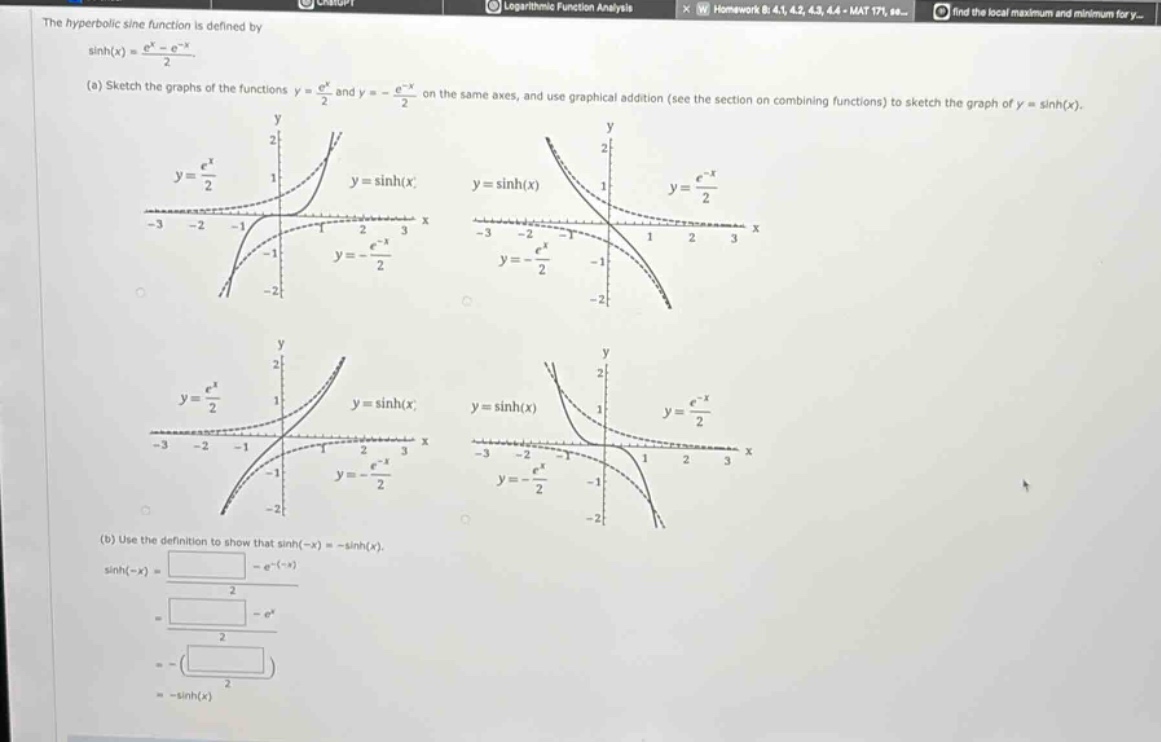
the hyperbolic sine function is defined by sinh(x)=(e^x - e^(-x))/2. (a) sketch the graphs of the functions y = e^x/2 and y=-e^(-x)/2 on the same axes, and use graphical addition (see the section on combining functions) to sketch the graph of y = sinh(x). (b) use the definition to show that sinh(-x)=-sinh(x). sinh(-x)=(e^(-x)-e^(-(-x)))/2=(e^(-x)-e^x)/2=-((e^x - e^(-x))/2)=-sinh(x)
Answer
Answer:
(a)
To sketch (y = \frac{e^{x}}{2}), we know that the exponential - function (y = e^{x}) has a (y) - intercept of (1) (when (x = 0), (y=1)), and it is an increasing function. The function (y=\frac{e^{x}}{2}) has a (y) - intercept of (\frac{1}{2}) (when (x = 0), (y=\frac{1}{2})) and is also an increasing function.
To sketch (y=-\frac{e^{-x}}{2}), when (x = 0), (y =-\frac{1}{2}). The function (y = e^{-x}=\left(\frac{1}{e}\right)^{x}) is a decreasing function, and (y =-\frac{e^{-x}}{2}) is a reflection of (y=\frac{e^{-x}}{2}) about the (x) - axis, so it is an increasing function as (x) increases.
To get the graph of (y=\sinh(x)=\frac{e^{x}-e^{-x}}{2}=\frac{e^{x}}{2}+\left(-\frac{e^{-x}}{2}\right)) using graphical addition, we add the (y) - values of (y = \frac{e^{x}}{2}) and (y=-\frac{e^{-x}}{2}) for each (x) value.
(b)
- Start with the definition of (\sinh(x)):
- Given (\sinh(x)=\frac{e^{x}-e^{-x}}{2}), then (\sinh(-x)=\frac{e^{-x}-e^{-(-x)}}{2}).
- Simplify the expression: (\sinh(-x)=\frac{e^{-x}-e^{x}}{2}).
- Factor out (- 1) from the numerator: (\sinh(-x)=-\frac{e^{x}-e^{-x}}{2}).
- Since (\sinh(x)=\frac{e^{x}-e^{-x}}{2}), we have (\sinh(-x)=-\sinh(x)).
So, for part (b): (\sinh(-x)=\frac{e^{-x}-e^{-(-x)}}{2}=\frac{e^{-x}-e^{x}}{2}=-\left(\frac{e^{x}-e^{-x}}{2}\right)=-\sinh(x))