identify the amplitude, period, phase shift, vertical shift, and the maximum and minimum values of the…
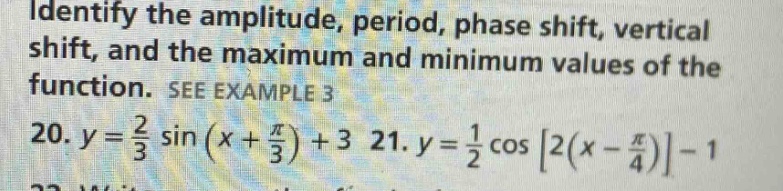
identify the amplitude, period, phase shift, vertical shift, and the maximum and minimum values of the function. see example 3\n20. $y = \\frac{2}{3} \\sin(x + \\frac{\\pi}{3})+3$ 21. $y = \\frac{1}{2} \\cos2(x - \\frac{\\pi}{4})-1$
Answer
For the function $y = \frac{2}{3}\sin(x+\frac{\pi}{3})+3$:
Explanation:
Step1: Find the amplitude
The amplitude $A$ of a sine function $y = A\sin(Bx - C)+D$ is given by the absolute - value of the coefficient of the sine term. Here, $A=\left|\frac{2}{3}\right|=\frac{2}{3}$.
Step2: Find the period
The period $T$ of a sine function $y = A\sin(Bx - C)+D$ is $T=\frac{2\pi}{|B|}$. Since $B = 1$, $T=\frac{2\pi}{|1|}=2\pi$.
Step3: Find the phase - shift
The phase - shift of a sine function $y = A\sin(Bx - C)+D$ is $\frac{C}{B}$. For $y=\frac{2}{3}\sin(x+\frac{\pi}{3})+3$, which can be written as $y=\frac{2}{3}\sin(1x-(-\frac{\pi}{3})) + 3$, the phase - shift is $-\frac{\pi}{3}$ (a shift to the left).
Step4: Find the vertical shift
The vertical shift $D$ of the function $y = A\sin(Bx - C)+D$ is the constant term. Here, $D = 3$.
Step5: Find the maximum and minimum values
The maximum value of $y = A\sin(Bx - C)+D$ is $A + D$ and the minimum value is $-A+D$. Maximum value: $\frac{2}{3}+3=\frac{2 + 9}{3}=\frac{11}{3}$ Minimum value: $-\frac{2}{3}+3=\frac{-2 + 9}{3}=\frac{7}{3}$
For the function $y=\frac{1}{2}\cos[2(x-\frac{\pi}{4})]-1$:
Step1: Find the amplitude
The amplitude $A$ of a cosine function $y = A\cos(Bx - C)+D$ is the absolute - value of the coefficient of the cosine term. So, $A=\left|\frac{1}{2}\right|=\frac{1}{2}$.
Step2: Find the period
The period $T$ of a cosine function $y = A\cos(Bx - C)+D$ is $T=\frac{2\pi}{|B|}$. Since $B = 2$, $T=\frac{2\pi}{|2|}=\pi$.
Step3: Find the phase - shift
The phase - shift of a cosine function $y = A\cos(Bx - C)+D$ is $\frac{C}{B}$. For $y=\frac{1}{2}\cos[2(x-\frac{\pi}{4})]-1=\frac{1}{2}\cos(2x-\frac{\pi}{2})-1$, the phase - shift is $\frac{\frac{\pi}{2}}{2}=\frac{\pi}{4}$ (a shift to the right).
Step4: Find the vertical shift
The vertical shift $D$ of the function $y = A\cos(Bx - C)+D$ is the constant term. Here, $D=-1$.
Step5: Find the maximum and minimum values
The maximum value of $y = A\cos(Bx - C)+D$ is $A + D$ and the minimum value is $-A+D$. Maximum value: $\frac{1}{2}-1=-\frac{1}{2}$ Minimum value: $-\frac{1}{2}-1=-\frac{3}{2}$
Answer:
For $y = \frac{2}{3}\sin(x+\frac{\pi}{3})+3$: Amplitude: $\frac{2}{3}$, Period: $2\pi$, Phase - shift: $-\frac{\pi}{3}$, Vertical shift: $3$, Maximum value: $\frac{11}{3}$, Minimum value: $\frac{7}{3}$ For $y=\frac{1}{2}\cos[2(x-\frac{\pi}{4})]-1$: Amplitude: $\frac{1}{2}$, Period: $\pi$, Phase - shift: $\frac{\pi}{4}$, Vertical shift: $-1$, Maximum value: $-\frac{1}{2}$, Minimum value: $-\frac{3}{2}$