identify any horizontal or vertical asymptotes in the graph. state the domain of f. determine the horizontal…
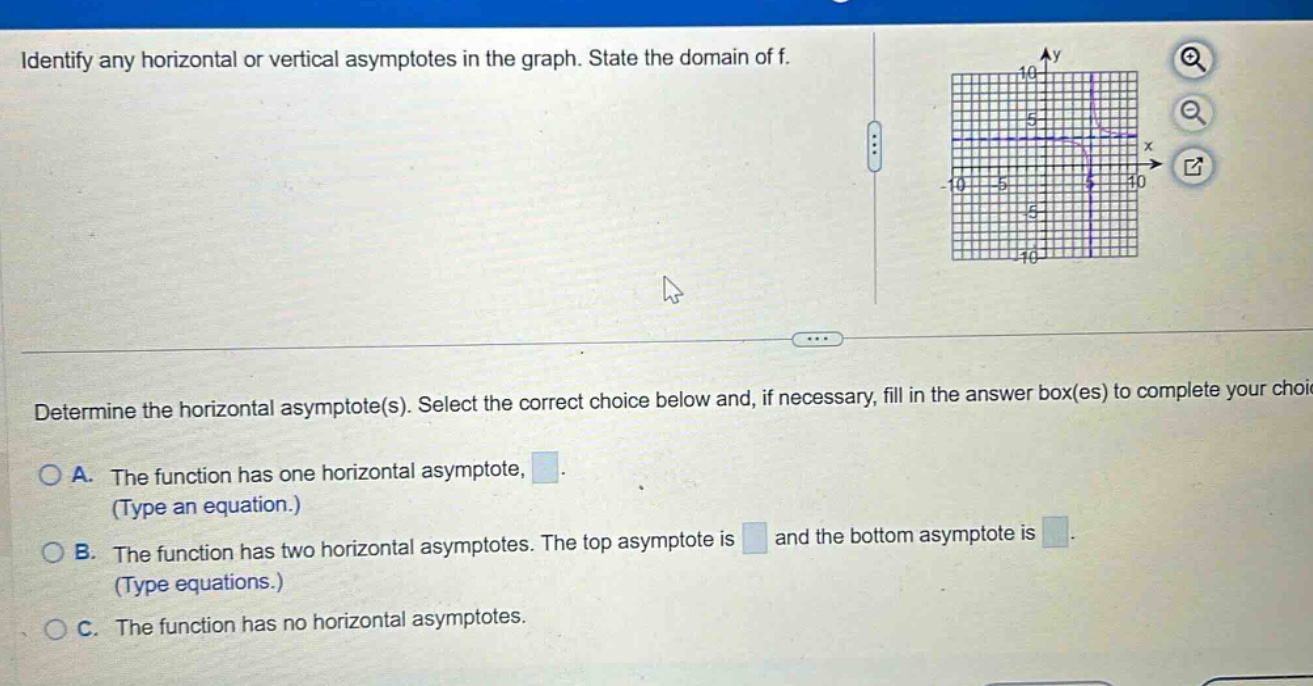
identify any horizontal or vertical asymptotes in the graph. state the domain of f. determine the horizontal asymptote(s). select the correct choice below and, if necessary, fill in the answer box(es) to complete your choice. a. the function has one horizontal asymptote, (type an equation.) b. the function has two horizontal asymptotes. the top asymptote is and the bottom asymptote is (type equations.) c. the function has no horizontal asymptotes.
Answer
Explanation:
Step1: Observe the graph behavior as x→±∞
As x approaches positive or negative infinity, check if the function approaches a constant value. If it does, that value gives the horizontal - asymptote equation.
Step2: Analyze the graph
From the graph, as x→±∞, the function approaches y = 0. So, the horizontal - asymptote equation is y = 0.
Answer:
A. The function has one horizontal asymptote, y = 0.