identify the asymptotes of the function: f(x) = \\frac{5}{x + 3}-6\na vertical asymptote: none horizontal…
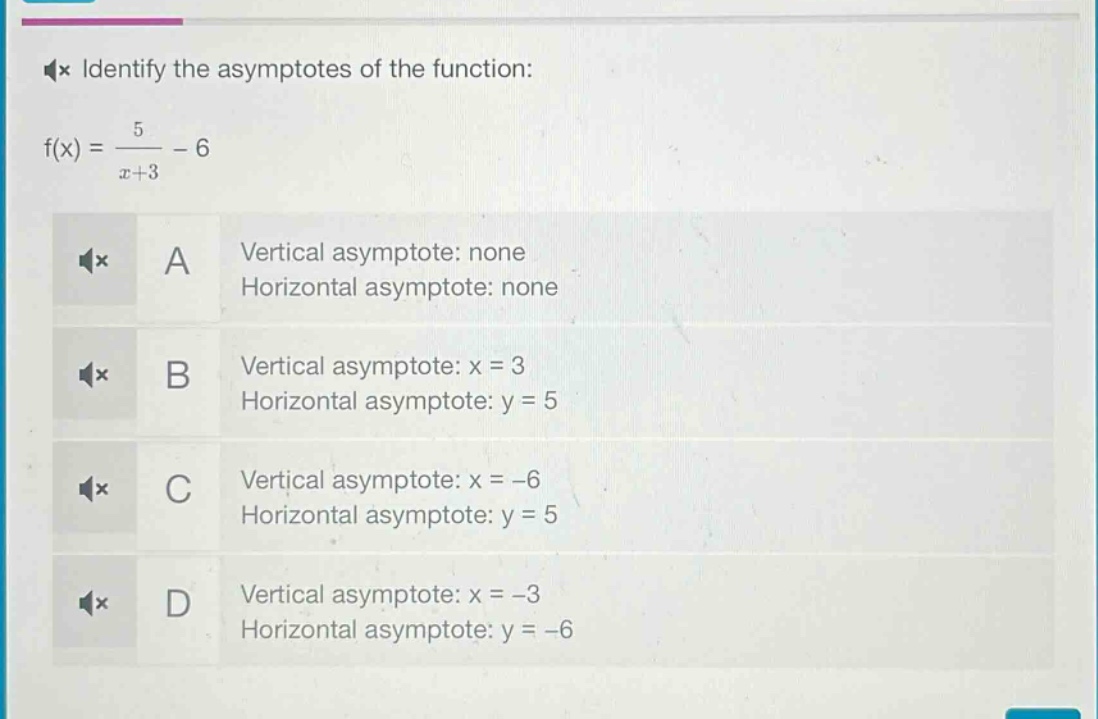
identify the asymptotes of the function: f(x) = \\frac{5}{x + 3}-6\na vertical asymptote: none horizontal asymptote: none\nb vertical asymptote: x = 3 horizontal asymptote: y = 5\nc vertical asymptote: x = -6 horizontal asymptote: y = 5\nd vertical asymptote: x = -3 horizontal asymptote: y = -6
Answer
Answer:
D. Vertical asymptote: $x = -3$, Horizontal asymptote: $y = -6$
Explanation:
Step1: Identify the vertical asymptote.
The vertical asymptote occurs where the denominator of the rational part of the function is zero. The function is $f(x) = \frac{5}{x+3} - 6$. Set the denominator to zero: $$x + 3 = 0$$ $$x = -3$$ Thus, the vertical asymptote is $x = -3$.
Step2: Identify the horizontal asymptote.
The horizontal asymptote is found by examining the limit of $f(x)$ as $x \to \pm\infty$. $$ \lim_{x \to \pm\infty} f(x) = \lim_{x \to \pm\infty} \left( \frac{5}{x+3} - 6 \right) $$ As $x \to \pm\infty$, the term $\frac{5}{x+3} \to 0$. $$ \lim_{x \to \pm\infty} f(x) = 0 - 6 = -6 $$ Thus, the horizontal asymptote is $y = -6$.