identify the following characteristics of the function f(x) = (x^2 - 9)/(16 - x^2): a. vertical asymptotes…
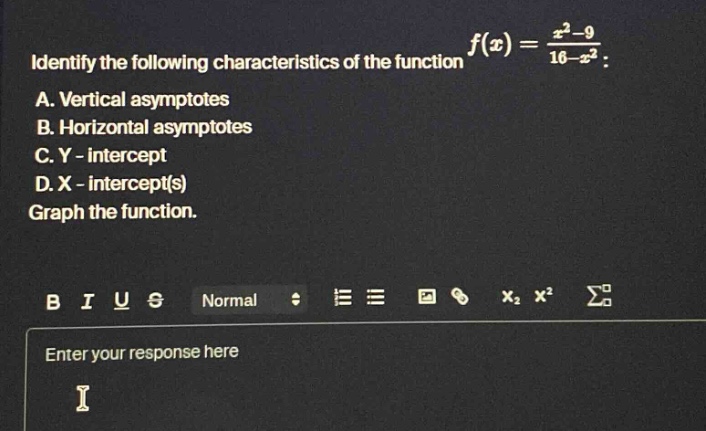
identify the following characteristics of the function f(x) = (x^2 - 9)/(16 - x^2): a. vertical asymptotes b. horizontal asymptotes c. y - intercept d. x - intercept(s) graph the function.
Answer
Explanation:
Step1: Find vertical asymptotes
Set the denominator equal to 0: $16 - x^{2}=0$. Then $(4 + x)(4 - x)=0$. Solving gives $x = 4$ and $x=-4$.
Step2: Find horizontal asymptotes
Degree of numerator $n = 2$ and degree of denominator $m = 2$. The leading - coefficient of numerator $a = 1$ and leading - coefficient of denominator $b=-1$. So, $\lim_{x\rightarrow\pm\infty}f(x)=\lim_{x\rightarrow\pm\infty}\frac{x^{2}-9}{16 - x^{2}}=\lim_{x\rightarrow\pm\infty}\frac{1-\frac{9}{x^{2}}}{\frac{16}{x^{2}}-1}=-1$. The horizontal asymptote is $y = - 1$.
Step3: Find y - intercept
Set $x = 0$: $f(0)=\frac{0^{2}-9}{16-0^{2}}=-\frac{9}{16}$.
Step4: Find x - intercepts
Set the numerator equal to 0: $x^{2}-9 = 0$. Then $(x + 3)(x - 3)=0$. So $x=3$ and $x = - 3$.
Answer:
A. Vertical asymptotes: $x = 4$ and $x=-4$ B. Horizontal asymptote: $y=-1$ C. Y - intercept: $(0,-\frac{9}{16})$ D. X - intercepts: $(3,0)$ and $(-3,0)$ To graph the function:
- Plot the vertical asymptotes $x = 4$ and $x=-4$ as dashed lines.
- Plot the horizontal asymptote $y=-1$ as a dashed line.
- Plot the y - intercept $(0,-\frac{9}{16})$ and x - intercepts $(3,0)$ and $(-3,0)$.
- Analyze the behavior of the function in the intervals $(-\infty,-4)$, $(-4,-3)$, $(-3,3)$, $(3,4)$ and $(4,\infty)$ by testing some values of $x$ in each interval. For example, in $(-\infty,-4)$ let $x=-5$, then $f(-5)=\frac{25 - 9}{16 - 25}=\frac{16}{-9}=-\frac{16}{9}$.