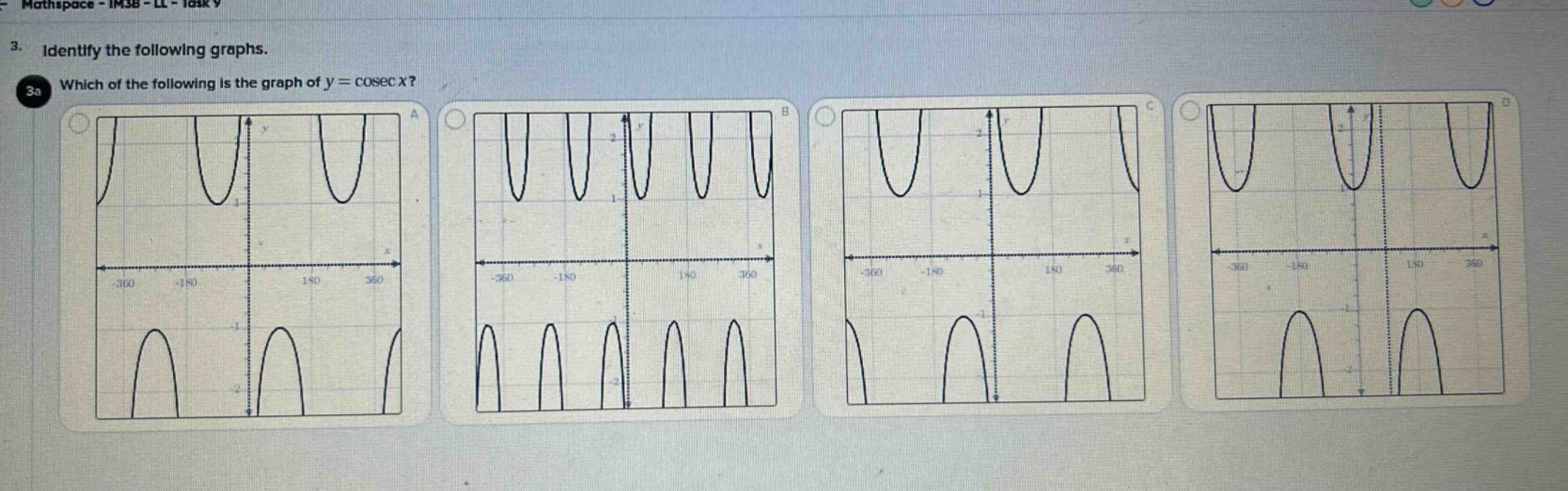
3. identify the following graphs.\n3a which of the following is the graph of y = cosec x?
3. identify the following graphs.\n3a which of the following is the graph of y = cosec x?
Answer
Answer:
The graph of (y = \csc x=\frac{1}{\sin x}) has vertical asymptotes at (x = n\pi), where (n\in\mathbb{Z}) (since (\sin x = 0) at these points), and it has local maxima and minima. The general shape of (y=\csc x) consists of U - shaped curves between consecutive vertical asymptotes. Without seeing the specific labels for the graphs A, B, C, D, we know that the graph of (y = \csc x) has the following properties:
- It is symmetric about the origin (it is an odd - function, (\csc(-x)=-\csc x)).
- The period of (y = \csc x) is (2\pi).
- The range is (y\leq - 1) or (y\geq1).
If we assume the standard orientation of the (x) - axis ((-360^{\circ}) to (360^{\circ}) where (x = 0) is in the middle), the correct graph should have vertical asymptotes at (x=- 360^{\circ},-180^{\circ},0^{\circ},180^{\circ},360^{\circ}) etc. and U - shaped curves above (y = 1) and below (y=-1) between consecutive asymptotes.
Explanation:
Step1: Recall the definition of cosecant
(y=\csc x=\frac{1}{\sin x})
Step2: Identify vertical asymptotes
Vertical asymptotes occur when (\sin x = 0), so (x=n\pi) ((n\in\mathbb{Z})). In degrees, (x = 180^{\circ}n), (n\in\mathbb{Z})
Step3: Determine range
Since (- 1\leq\sin x\leq1) and (\csc x=\frac{1}{\sin x}), the range of (y = \csc x) is (y\leq - 1) or (y\geq1)
Step4: Analyze symmetry and period
(\csc(-x)=-\csc x), so it is odd - symmetric about the origin. The period of (\sin x) is (2\pi) (or (360^{\circ})), so the period of (\csc x) is also (2\pi) (or (360^{\circ}))