identify the function represented by the following power series. \n∑(k = 1 to ∞) (-1)^k (kx^(k + 1))/4^k…
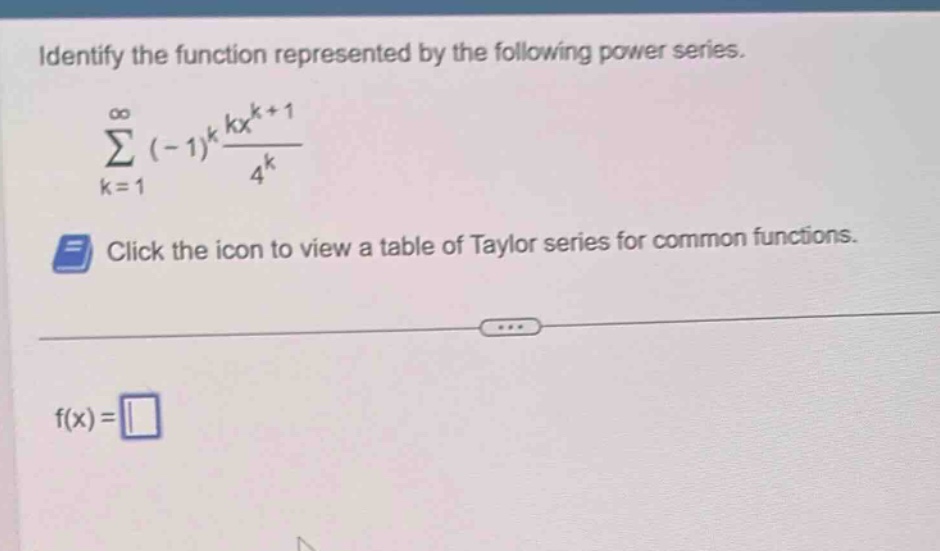
identify the function represented by the following power series. \n∑(k = 1 to ∞) (-1)^k (kx^(k + 1))/4^k \nclick the icon to view a table of taylor series for common functions. \nf(x) =
Answer
Explanation:
Step1: Recall geometric - series form
The geometric series is $\sum_{k = 0}^{\infty}r^{k}=\frac{1}{1 - r}$, for $|r|\lt1$. First, rewrite the given power - series $\sum_{k = 1}^{\infty}(-1)^{k}\frac{kx^{k + 1}}{4^{k}}=x^{2}\sum_{k = 1}^{\infty}k(-\frac{x}{4})^{k}$.
Step2: Start from the geometric series
We know that $\sum_{k = 0}^{\infty}t^{k}=\frac{1}{1 - t}$, for $|t|\lt1$. Differentiate both sides with respect to $t$: $\frac{d}{dt}\sum_{k = 0}^{\infty}t^{k}=\sum_{k = 1}^{\infty}kt^{k - 1}=\frac{1}{(1 - t)^{2}}$. Then $\sum_{k = 1}^{\infty}kt^{k}=\frac{t}{(1 - t)^{2}}$.
Step3: Substitute $t=-\frac{x}{4}$
Let $t =-\frac{x}{4}$. Then $\sum_{k = 1}^{\infty}k(-\frac{x}{4})^{k}=\frac{-\frac{x}{4}}{(1+\frac{x}{4})^{2}}=\frac{-x}{(4 + x)^{2}}$.
Step4: Multiply by $x^{2}$
Since our original series is $x^{2}\sum_{k = 1}^{\infty}k(-\frac{x}{4})^{k}$, we have $f(x)=x^{2}\cdot\frac{-x}{(4 + x)^{2}}=\frac{-x^{3}}{(4 + x)^{2}}$, for $|-\frac{x}{4}|\lt1$ (i.e., $|x|\lt4$).
Answer:
$\frac{-x^{3}}{(4 + x)^{2}}$