identify the function whose graph appears above.\nf(x) =
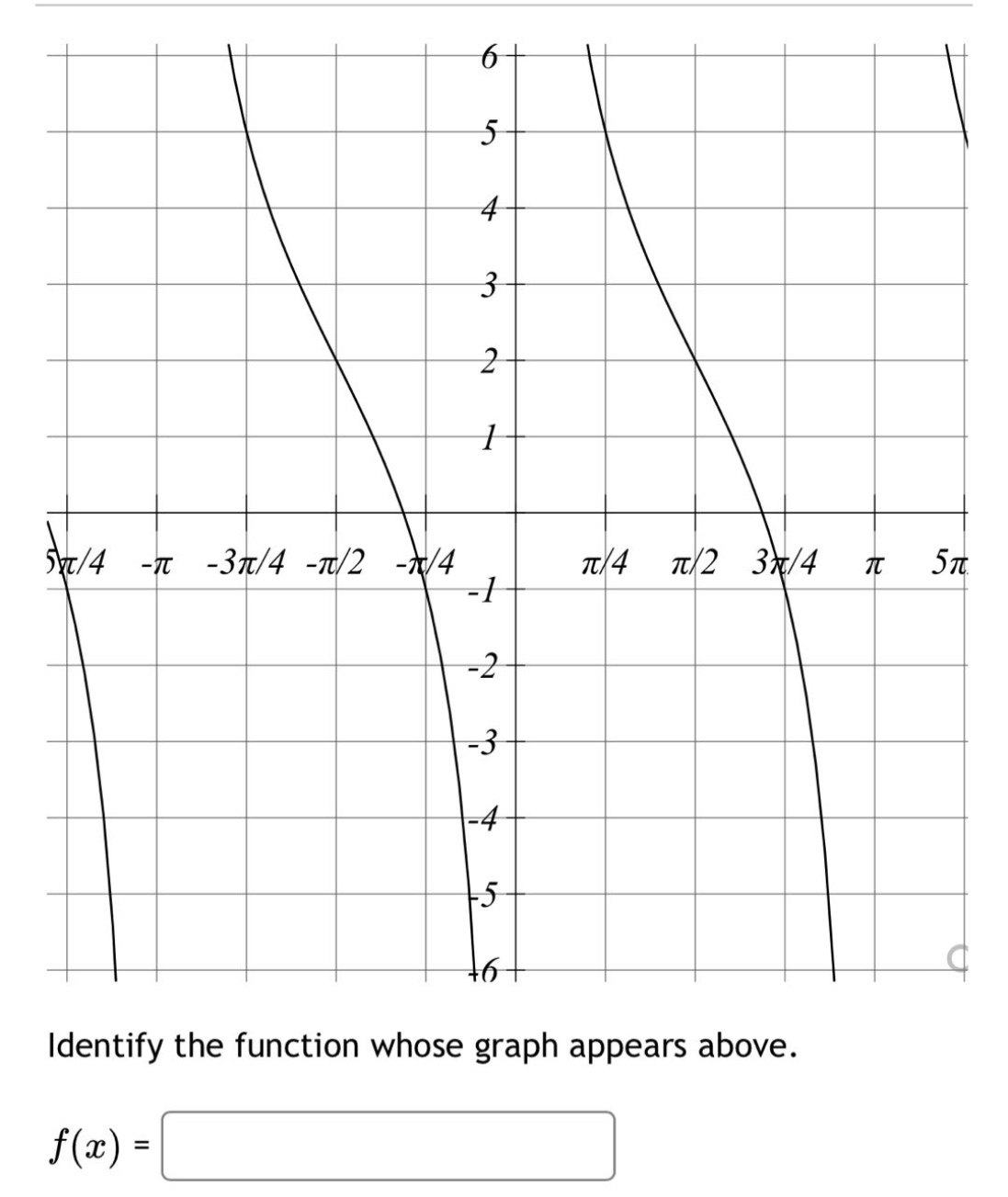
identify the function whose graph appears above.\nf(x) =
Answer
Explanation:
Step1: Analyze key - features
The graph has vertical asymptotes at (x =-\frac{\pi}{2}, \frac{\pi}{2},\frac{3\pi}{2}\cdots). This is a characteristic of the tangent or cotangent functions. The general form of the tangent function is (y = A\tan(Bx - C)+D).
Step2: Determine the period
The period of the tangent function (y = A\tan(Bx - C)+D) is (T=\frac{\pi}{|B|}). The distance between consecutive vertical asymptotes is (\pi), so (B = 1).
Step3: Check for vertical and horizontal shifts
There is no horizontal shift ((C = 0)) and no vertical shift ((D=0)). Also, when (x = 0), (y = 0). The amplitude of the tangent function is not applicable in the traditional sense as it is a non - periodic function with vertical asymptotes. The basic tangent function (y=\tan(x)) passes through the origin and has vertical asymptotes at (x=(n+\frac{1}{2})\pi,n\in\mathbb{Z}).
Answer:
(\tan(x))