identify the graph of the function y = √x. determine when the function is positive, negative, increasing or…
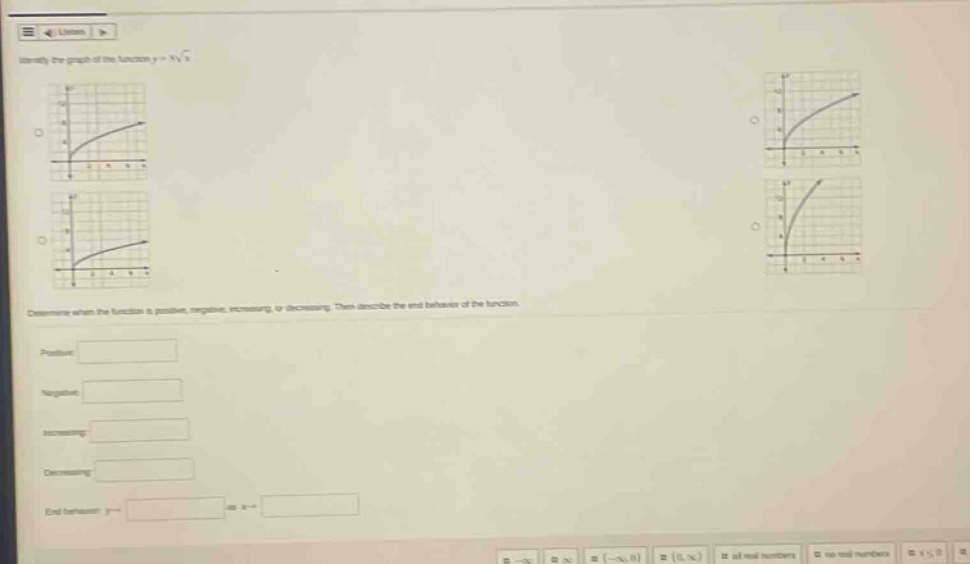
identify the graph of the function y = √x. determine when the function is positive, negative, increasing or decreasing. then describe the end - behavior of the function. positive: blank negative: blank increasing: blank decreasing: blank end behavior: y→ blank as x→ blank
Answer
Explanation:
Step1: Analyze domain and range
The function is $y = \sqrt[3]{x}$. The domain is all real - numbers ($x\in(-\infty,\infty)$) since we can take the cube - root of any real number. When $x = 0$, $y = 0$; as $x$ increases, $y$ increases and as $x$ decreases, $y$ decreases.
Step2: Determine sign of the function
For positive values of $x$, $\sqrt[3]{x}>0$. For negative values of $x$, $\sqrt[3]{x}<0$. When $x = 0$, $\sqrt[3]{x}=0$.
Step3: Check for increasing or decreasing
The derivative of $y=\sqrt[3]{x}=x^{\frac{1}{3}}$ is $y'=\frac{1}{3}x^{-\frac{2}{3}}=\frac{1}{3x^{\frac{2}{3}}}>0$ for all $x\neq0$. And the function is continuous at $x = 0$. So the function is increasing on $(-\infty,\infty)$.
Step4: Analyze end - behavior
As $x\to-\infty$, $y=\sqrt[3]{x}\to-\infty$; as $x\to\infty$, $y=\sqrt[3]{x}\to\infty$.
Answer:
Positive: $(0,\infty)$ Negative: $(-\infty,0)$ Increasing: $(-\infty,\infty)$ Decreasing: None End behavior: $y\to-\infty$ as $x\to-\infty$; $y\to\infty$ as $x\to\infty$