identify the graph of the function y = 5√x. determine when the function is positive, negative, increasing…
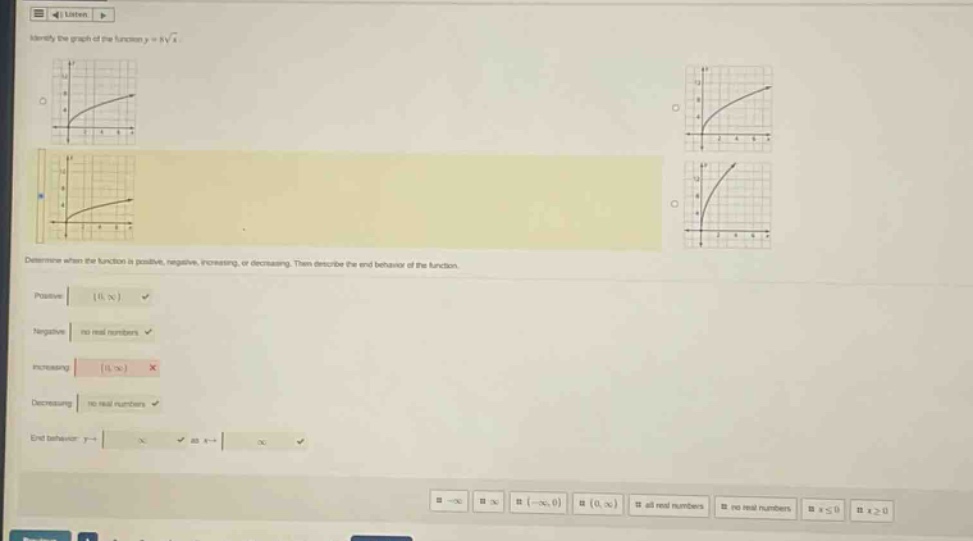
identify the graph of the function y = 5√x. determine when the function is positive, negative, increasing, or decreasing. then describe the end - behavior of the function. positive: (1, ∞) negative: no real numbers increasing: (0, ∞) decreasing: no real numbers end behavior: y→ as x→
Answer
Explanation:
Step1: Analyze domain and range
The function is $y = 5\sqrt{x}$. The domain of $y = 5\sqrt{x}$ is $x\geq0$ since we can't take the square - root of a negative number in the real - number system. When $x = 0$, $y = 0$; as $x$ increases, $y$ also increases.
Step2: Determine sign of the function
For $x\geq0$, $y = 5\sqrt{x}\geq0$. So the function is non - negative on its domain $[0,\infty)$ and there are no real numbers for which it is negative.
Step3: Check increasing or decreasing nature
Take the derivative of $y = 5\sqrt{x}=5x^{\frac{1}{2}}$. Using the power rule $y^\prime=\frac{5}{2\sqrt{x}}>0$ for $x > 0$. So the function is increasing on the interval $(0,\infty)$. At $x = 0$, the derivative is undefined in the strict sense, but considering the behavior of the function, we can say it is increasing on $[0,\infty)$.
Step4: Analyze end - behavior
As $x\to\infty$, $y = 5\sqrt{x}\to\infty$.
Answer:
Positive: $[0,\infty)$ Negative: no real numbers Increasing: $[0,\infty)$ Decreasing: no real numbers End behavior: $y\to\infty$ as $x\to\infty$