identify the inflection points and local maxima and minima of the graphed function. identify the open…
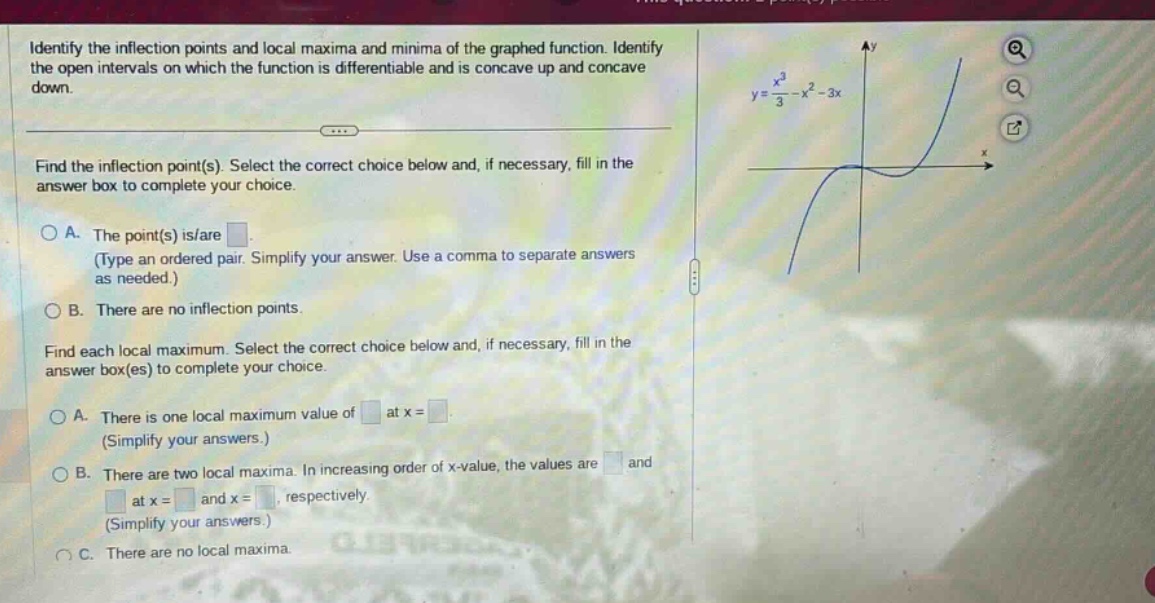
identify the inflection points and local maxima and minima of the graphed function. identify the open intervals on which the function is differentiable and is concave up and concave down. find the inflection point(s). select the correct choice below and, if necessary, fill in the answer box to complete your choice. a. the point(s) is/are. (type an ordered pair. simplify your answer. use a comma to separate answers as needed.) b. there are no inflection points. find each local maximum. select the correct choice below and, if necessary, fill in the answer box(es) to complete your choice. a. there is one local maximum value of at x =. (simplify your answers.) b. there are two local maxima. in increasing order of x - value, the values are and at x = and x =, respectively. (simplify your answers.) c. there are no local maxima.
Answer
Explanation:
Step1: Find the first - derivative
Given $y = \frac{x^{3}}{3}-x^{2}-3x$. Using the power rule $\frac{d}{dx}(x^{n})=nx^{n - 1}$, we have $y'=x^{2}-2x - 3$.
Step2: Find the critical points
Set $y' = 0$, so $x^{2}-2x - 3=(x - 3)(x+1)=0$. Solving gives $x=-1$ and $x = 3$.
Step3: Find the second - derivative
Differentiate $y'=x^{2}-2x - 3$ with respect to $x$. Using the power rule, $y'' = 2x-2$.
Step4: Find the inflection point
Set $y''=0$, then $2x - 2=0$, which gives $x = 1$. When $x = 1$, $y=\frac{1^{3}}{3}-1^{2}-3\times1=\frac{1}{3}-1 - 3=\frac{1 - 3-9}{3}=-\frac{11}{3}$. So the inflection point is $(1,-\frac{11}{3})$.
Step5: Determine local maxima and minima
Use the first - derivative test. For $x<-1$, let $x=-2$, then $y'=(-2)^{2}-2\times(-2)-3=4 + 4-3 = 5>0$, so the function is increasing. For $-1<x<3$, let $x = 0$, then $y'=0^{2}-2\times0 - 3=-3<0$, so the function is decreasing. For $x>3$, let $x = 4$, then $y'=4^{2}-2\times4 - 3=16-8 - 3 = 5>0$, so the function is increasing. Since the function changes from increasing to decreasing at $x=-1$, $y(-1)=\frac{(-1)^{3}}{3}-(-1)^{2}-3\times(-1)=-\frac{1}{3}-1 + 3=\frac{-1 - 3 + 9}{3}=\frac{5}{3}$ is a local maximum.
Answer:
Find the inflection point(s): A. The point(s) is/are $(1,-\frac{11}{3})$ Find each local maximum: A. There is one local maximum value of $\frac{5}{3}$ at $x=-1$