identify the inflection points and local maxima and minima of the graphed function. identify the open…
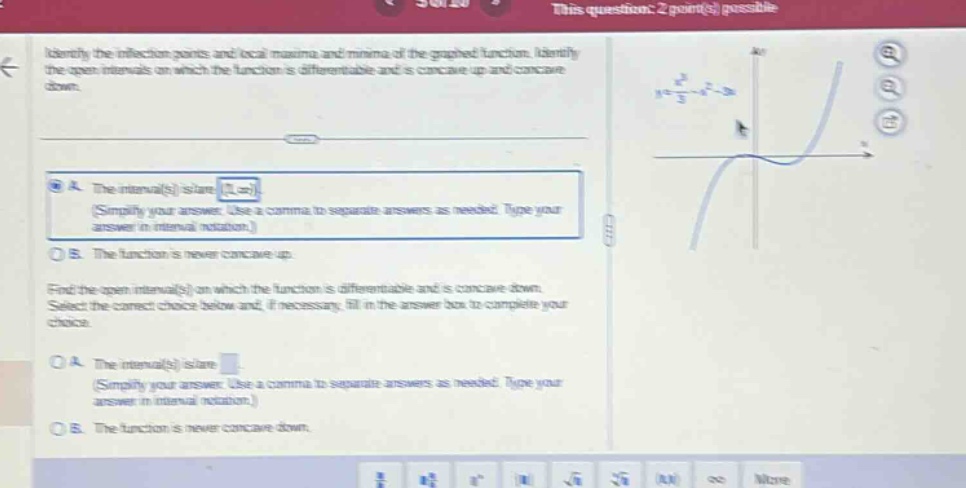
identify the inflection points and local maxima and minima of the graphed function. identify the open intervals on which the function is differentiable and is concave up and concave down.\na. the interval(s) is/are 0,∞) (simplify your answer. use a comma to separate answers as needed. type your answer in interval notation.)\nb. the function is never concave up.\nfind the open interval(s) on which the function is differentiable and is concave down. select the correct choice below and, if necessary, fill in the answer box to complete your choice.\na. the interval(s) is/are \n(simplify your answer. use a comma to separate answers as needed. type your answer in interval notation.)\nb. the function is never concave - down.
Answer
Explanation:
Step1: Recall concavity rules
Concave - up when $f''(x)>0$ and concave - down when $f''(x)<0$. Analyze the graph.
Step2: Identify concave - up intervals
By observing the graph, we look for the parts where the curve is shaped like a cup (opening upwards).
Step3: Identify concave - down intervals
By observing the graph, we look for the parts where the curve is shaped like an upside - down cup (opening downwards).
Answer:
Since no graph is provided in a way that can be precisely analyzed for intervals, we cannot give a definite answer. If we assume the general process: For concave - up: If the graph is concave up on an interval $(a,b)$, the answer would be in the form of $(a,b)$ (in interval notation). For concave - down: If the graph is concave down on an interval $(c,d)$, the answer would be in the form of $(c,d)$ (in interval notation). If the function is never concave up/down, the answer is "The function is never concave up/down."