identify the location and value of any relative maxima or minima of the function. ignore points on the…
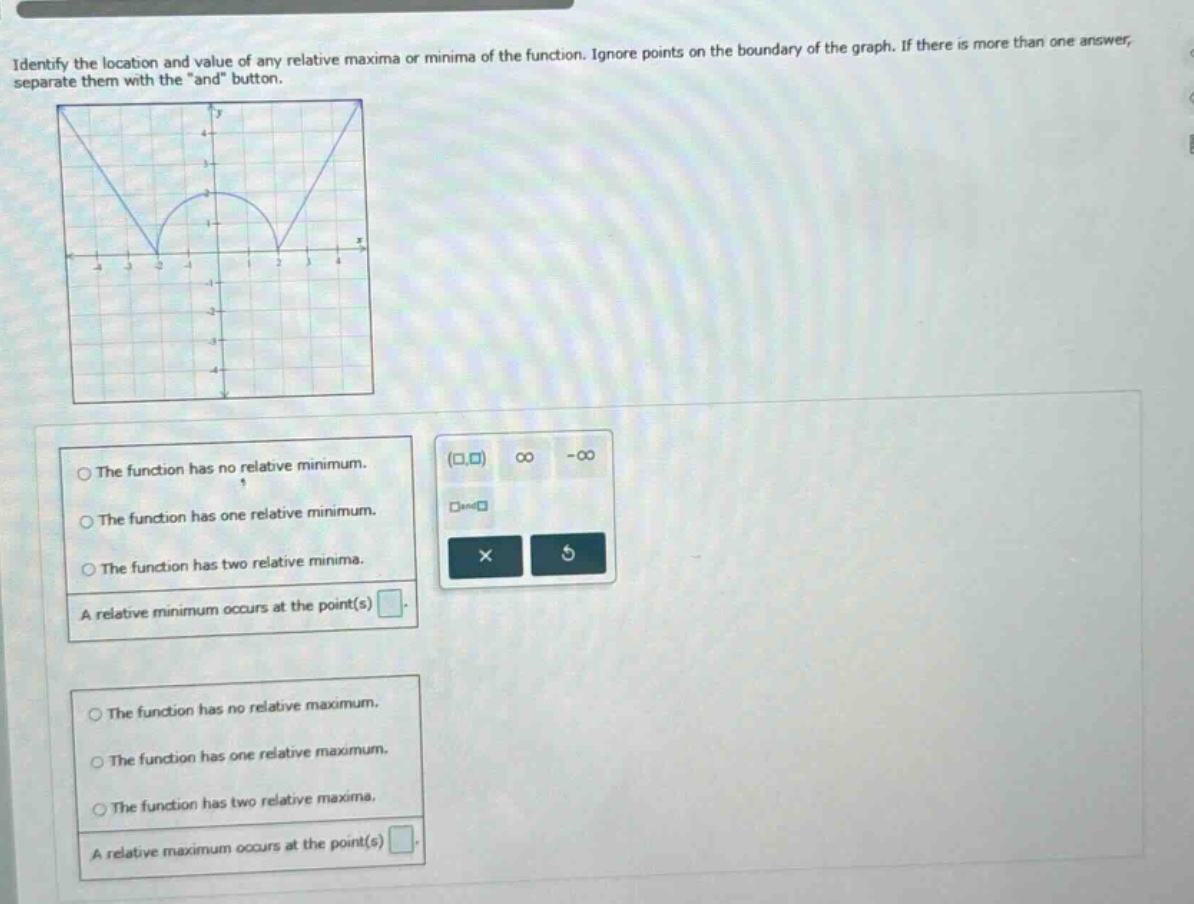
identify the location and value of any relative maxima or minima of the function. ignore points on the boundary of the graph. if there is more than one answer, separate them with the \and\ button. the function has no relative minimum. the function has one relative minimum. the function has two relative minima. a relative minimum occurs at the point(s) . the function has no relative maximum. the function has one relative maximum. the function has two relative maxima. a relative maximum occurs at the point(s)
Answer
Explanation:
Step1: Recall relative - extrema definition
A relative minimum is a point where the function changes from decreasing to increasing, and a relative maximum is a point where the function changes from increasing to decreasing.
Step2: Analyze the graph
Looking at the graph, we see that the function has two points where it changes from decreasing to increasing (valleys) and one point where it changes from increasing to decreasing (peak).
Answer:
The function has two relative minima. A relative minimum occurs at the points (-2, - 2) and (2, - 2). The function has one relative maximum. A relative maximum occurs at the point (0, 2).