identify the maximum, minimum, and period of the function\nmaximum: 7 minimum: 5 period: 10\\pi\n\nplot 5…
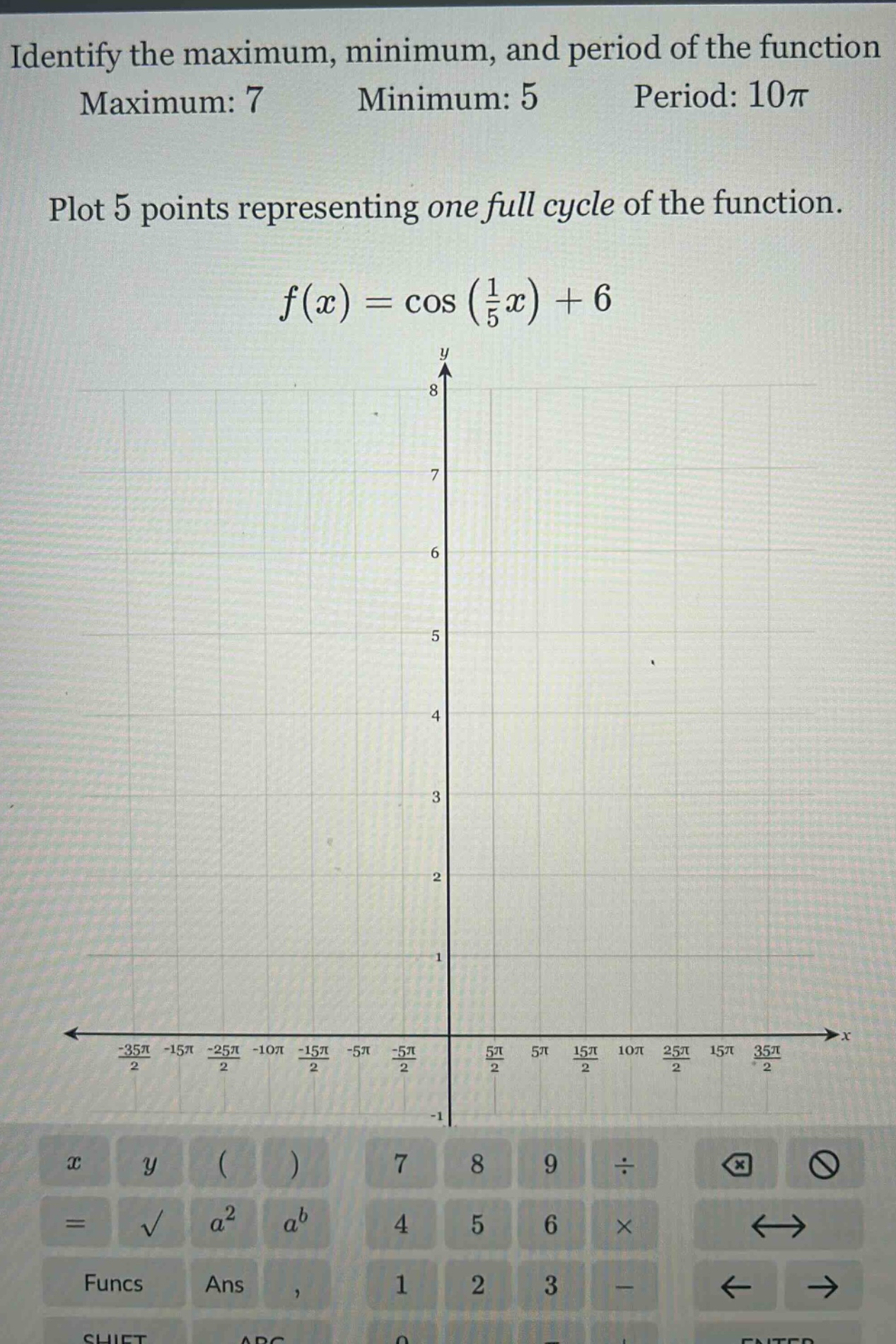
identify the maximum, minimum, and period of the function\nmaximum: 7 minimum: 5 period: 10\\pi\n\nplot 5 points representing one full cycle of the function.\n\n$f(x)=\\cos(\\frac{1}{5}x)+6$
Answer
Answer:
The five points representing one full cycle are: $(0, 7)$ $(\frac{5\pi}{2}, 6)$ $(5\pi, 5)$ $(\frac{15\pi}{2}, 6)$ $(10\pi, 7)$
Explanation:
Step1: Understand the function and its parameters.
The given function is $f(x) = \cos(\frac{1}{5}x) + 6$. This is a cosine function of the form $A \cos(Bx - C) + D$. Here, amplitude $A=1$, coefficient $B=\frac{1}{5}$, phase shift $C=0$, and vertical shift $D=6$.
Step2: Confirm the maximum, minimum, and period.
Maximum value: $D + |A| = 6 + |1| = 7$. Minimum value: $D - |A| = 6 - |1| = 5$. Period: $P = \frac{2\pi}{|B|} = \frac{2\pi}{\frac{1}{5}} = 10\pi$. These values match the information provided in the problem statement.
Step3: Determine the x-coordinates for five key points.
One cycle of $f(x)$ starts at $x=0$ and ends at $x=P=10\pi$. Key points divide the period into four equal parts. $x_1 = 0$ $x_2 = \frac{P}{4} = \frac{10\pi}{4} = \frac{5\pi}{2}$ $x_3 = \frac{P}{2} = \frac{10\pi}{2} = 5\pi$ $x_4 = \frac{3P}{4} = \frac{3 \cdot 10\pi}{4} = \frac{15\pi}{2}$ $x_5 = P = 10\pi$
Step4: Calculate the y-coordinates for these x-values.
$f(x_1) = f(0) = \cos(\frac{1}{5} \cdot 0) + 6 = \cos(0) + 6 = 1 + 6 = 7$. Point 1: $(0, 7)$. $f(x_2) = f(\frac{5\pi}{2}) = \cos(\frac{1}{5} \cdot \frac{5\pi}{2}) + 6 = \cos(\frac{\pi}{2}) + 6 = 0 + 6 = 6$. Point 2: $(\frac{5\pi}{2}, 6)$. $f(x_3) = f(5\pi) = \cos(\frac{1}{5} \cdot 5\pi) + 6 = \cos(\pi) + 6 = -1 + 6 = 5$. Point 3: $(5\pi, 5)$. $f(x_4) = f(\frac{15\pi}{2}) = \cos(\frac{1}{5} \cdot \frac{15\pi}{2}) + 6 = \cos(\frac{3\pi}{2}) + 6 = 0 + 6 = 6$. Point 4: $(\frac{15\pi}{2}, 6)$. $f(x_5) = f(10\pi) = \cos(\frac{1}{5} \cdot 10\pi) + 6 = \cos(2\pi) + 6 = 1 + 6 = 7$. Point 5: $(10\pi, 7)$.