identify and sketch the graph of the polar equation. r = 3 cos(4θ) lemniscatecirclelimaconrose curve…
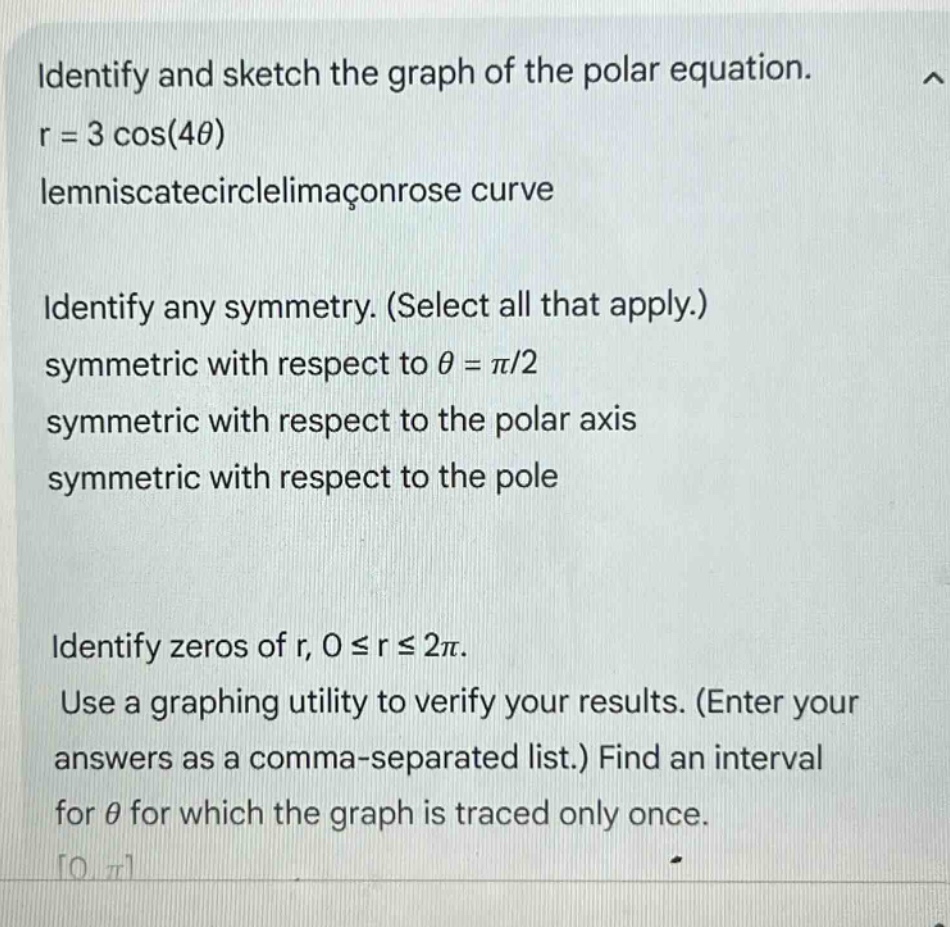
identify and sketch the graph of the polar equation. r = 3 cos(4θ) lemniscatecirclelimaconrose curve identify any symmetry. (select all that apply.) symmetric with respect to θ = π/2 symmetric with respect to the polar axis symmetric with respect to the pole identify zeros of r, 0 ≤ r ≤ 2π. use a graphing utility to verify your results. (enter your answers as a comma - separated list.) find an interval for θ for which the graph is traced only once. 0,π
Answer
Explanation:
Step1: Identify the curve type
The general form of a rose - curve in polar coordinates is $r = a\cos(n\theta)$ or $r=a\sin(n\theta)$. Here $a = 3$ and $n = 4$. Since $n$ is an even positive integer, the polar equation $r = 3\cos(4\theta)$ represents a rose curve.
Step2: Check for symmetry
Symmetry about $\theta=\frac{\pi}{2}$:
Replace $\theta$ with $\pi-\theta$. Then $r = 3\cos(4(\pi - \theta))=3\cos(4\pi-4\theta)=3\cos(4\theta)$ (using the identity $\cos(A - B)=\cos A\cos B+\sin A\sin B$ and $\cos(4\pi)=1,\sin(4\pi)=0$). So the curve is symmetric about $\theta=\frac{\pi}{2}$.
Symmetry about the polar axis:
Replace $\theta$ with $-\theta$. Then $r = 3\cos(- 4\theta)=3\cos(4\theta)$ (since $\cos(-x)=\cos x$). So the curve is symmetric about the polar axis.
Symmetry about the pole:
Replace $r$ with $-r$. Then $-r = 3\cos(4\theta)$ or $r=-3\cos(4\theta)$, which is not the same as the original equation. Replace $\theta$ with $\theta+\pi$. Then $r = 3\cos(4(\theta+\pi))=3\cos(4\theta + 4\pi)=3\cos(4\theta)$. So the curve is symmetric about the pole.
Step3: Find the zeros of $r$
Set $r = 3\cos(4\theta)=0$. Then $\cos(4\theta)=0$. We know that $\cos x = 0$ when $x=(2k + 1)\frac{\pi}{2},k\in\mathbb{Z}$. So $4\theta=(2k + 1)\frac{\pi}{2}$, and $\theta=\frac{(2k + 1)\pi}{8}$, where $k = 0,1,\cdots,7$. For $0\leq\theta\leq2\pi$, the zeros of $r$ are $\theta=\frac{\pi}{8},\frac{3\pi}{8},\frac{5\pi}{8},\frac{7\pi}{8},\frac{9\pi}{8},\frac{11\pi}{8},\frac{13\pi}{8},\frac{15\pi}{8}$.
Step4: Find the interval for $\theta$ to trace the graph once
For a rose - curve $r = a\cos(n\theta)$ with $n$ even, the graph is traced out once on the interval $[0,\pi]$.
Answer:
Curve type: rose curve Symmetry: symmetric with respect to $\theta=\frac{\pi}{2}$, symmetric with respect to the polar axis, symmetric with respect to the pole Zeros of $r$: $\frac{\pi}{8},\frac{3\pi}{8},\frac{5\pi}{8},\frac{7\pi}{8},\frac{9\pi}{8},\frac{11\pi}{8},\frac{13\pi}{8},\frac{15\pi}{8}$ Interval for $\theta$: $[0,\pi]$