identify the statements among a - h that follow directly from the given condition about x. the graph of (y =…
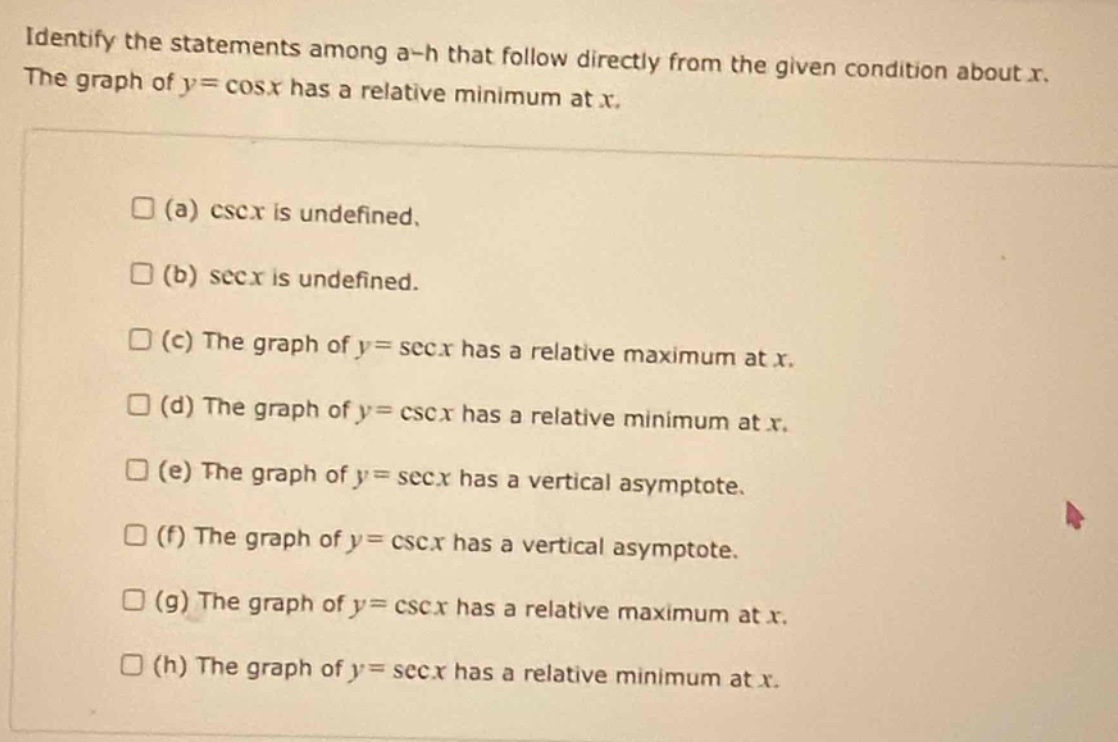
identify the statements among a - h that follow directly from the given condition about x. the graph of (y = cos x) has a relative minimum at x.\n(a) (csc x) is undefined.\n(b) (sec x) is undefined.\n(c) the graph of (y=sec x) has a relative maximum at x.\n(d) the graph of (y = csc x) has a relative minimum at x.\n(e) the graph of (y=sec x) has a vertical asymptote.\n(f) the graph of (y = csc x) has a vertical asymptote.\n(g) the graph of (y = csc x) has a relative maximum at x.\n(h) the graph of (y=sec x) has a relative minimum at x.
Answer
Explanation:
Step1: Recall trigonometric identities
We know that $\csc x=\frac{1}{\sin x}$ and $\sec x = \frac{1}{\cos x}$. A relative - minimum of $y = \cos x$ occurs when $\cos x=- 1$.
Step2: Analyze each statement
When $\cos x=-1$, $\sin x = 0$.
- For (a): $\csc x=\frac{1}{\sin x}$, when $\sin x = 0$, $\csc x$ is undefined.
- For (b): When $\cos x=-1$, $\sec x=\frac{1}{\cos x}=-1$, so $\sec x$ is defined.
- For (c): Since $\sec x=\frac{1}{\cos x}$, when $\cos x$ has a relative - minimum of $-1$, $\sec x$ has a relative - maximum of $-1$.
- For (d): When $\cos x$ has a relative - minimum, $\sin x = 0$, and $\csc x$ is undefined, not having a relative minimum.
- For (e): When $\cos x$ has a relative - minimum, $\cos x=-1$, and $\sec x=-1$, there is no vertical asymptote.
- For (f): When $\cos x$ has a relative - minimum, $\sin x = 0$, and $\csc x$ has a vertical asymptote.
- For (g): When $\cos x$ has a relative - minimum, $\sin x = 0$, and $\csc x$ is undefined, not having a relative maximum.
- For (h): When $\cos x$ has a relative - minimum of $-1$, $\sec x$ has a relative - maximum of $-1$, not a relative minimum.
Answer:
(a) $\csc x$ is undefined. (c) The graph of $y = \sec x$ has a relative maximum at $x$. (f) The graph of $y=\csc x$ has a vertical asymptote.