2. identify the x - values for which each of the following functions has a critical point. then determine…
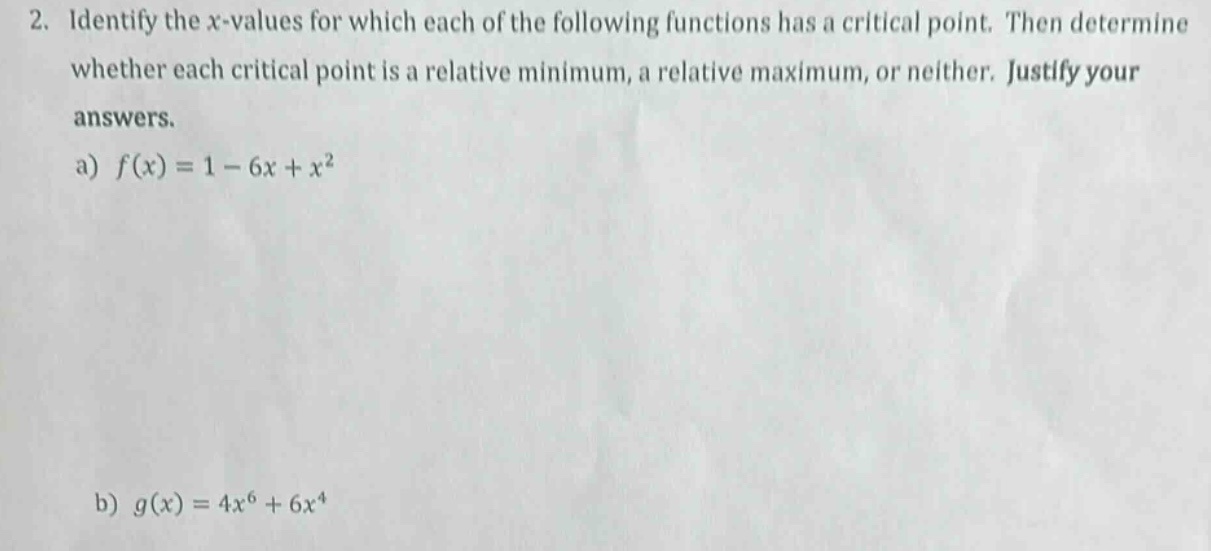
2. identify the x - values for which each of the following functions has a critical point. then determine whether each critical point is a relative minimum, a relative maximum, or neither. justify your answers.\na) (f(x)=1 - 6x + x^{2})\nb) (g(x)=4x^{6}+6x^{4})
Answer
Explanation:
Step1: Find the derivative of $f(x)$
Differentiate $f(x)=1 - 6x+x^{2}$ using power - rule. $f^\prime(x)=\frac{d}{dx}(1)-6\frac{d}{dx}(x)+\frac{d}{dx}(x^{2})=0 - 6+2x = 2x - 6$.
Step2: Find the critical points of $f(x)$
Set $f^\prime(x)=0$. So, $2x - 6=0$. Solving for $x$ gives $2x=6$, then $x = 3$.
Step3: Use the second - derivative test for $f(x)$
Differentiate $f^\prime(x)$ to get the second - derivative. $f^{\prime\prime}(x)=\frac{d}{dx}(2x - 6)=2$. Since $f^{\prime\prime}(3)=2>0$, the function $f(x)$ has a relative minimum at $x = 3$.
Step4: Find the derivative of $g(x)$
Differentiate $g(x)=4x^{6}+6x^{4}$ using power - rule. $g^\prime(x)=4\times6x^{5}+6\times4x^{3}=24x^{5}+24x^{3}=24x^{3}(x^{2}+1)$.
Step5: Find the critical points of $g(x)$
Set $g^\prime(x)=0$. Since $x^{2}+1>0$ for all real $x$, then $24x^{3}=0$, which gives $x = 0$.
Step6: Use the second - derivative test for $g(x)$
Differentiate $g^\prime(x)$ to get the second - derivative. $g^{\prime\prime}(x)=24\times5x^{4}+24\times3x^{2}=120x^{4}+72x^{2}$. Evaluate $g^{\prime\prime}(0)=0$. We can also analyze the sign of $g^\prime(x)$ around $x = 0$. For $x<0$, $g^\prime(x)<0$ (e.g., if $x=-1$, $g^\prime(-1)=24\times(-1)^{3}((-1)^{2}+1)=-48<0$), and for $x>0$, $g^\prime(x)>0$ (e.g., if $x = 1$, $g^\prime(1)=24\times1^{3}(1^{2}+1)=48>0$). So, $g(x)$ has a relative minimum at $x = 0$.
Answer:
a) The critical point of $f(x)$ is $x = 3$, and it is a relative minimum. b) The critical point of $g(x)$ is $x = 0$, and it is a relative minimum.