identify whether each value of x is a discontinuity of the function by typing asymptote, hole, or…
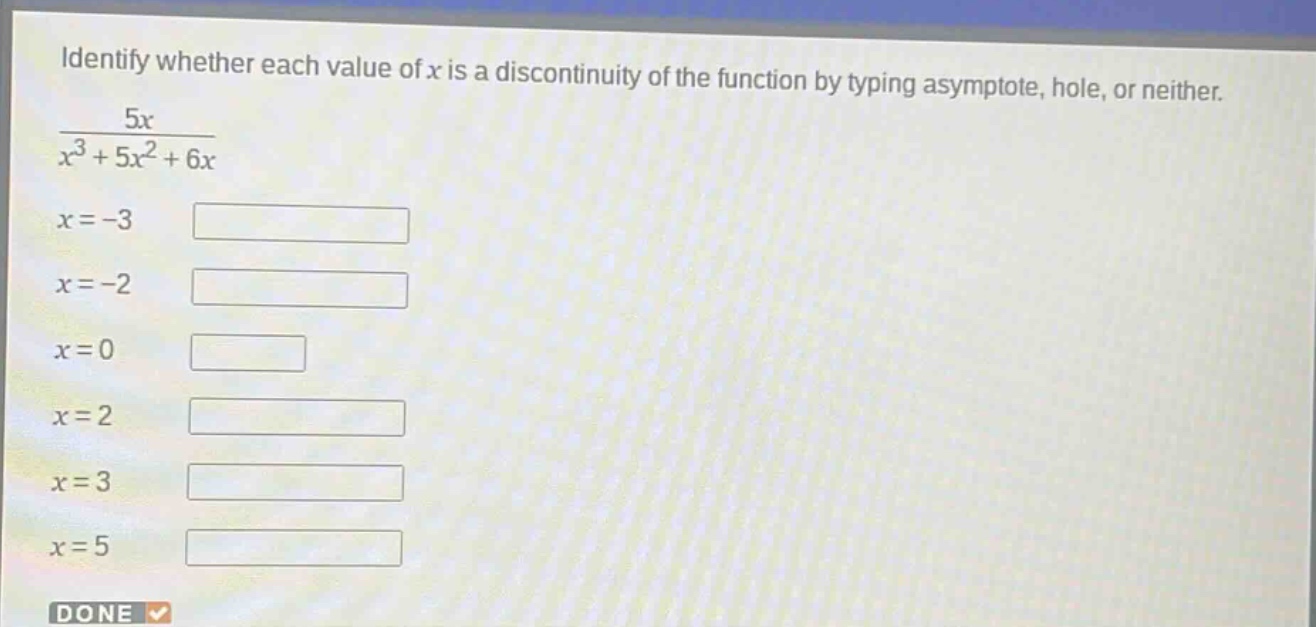
identify whether each value of x is a discontinuity of the function by typing asymptote, hole, or neither.\n$\frac{5x}{x^{3}+5x^{2}+6x}$\n$x = - 3$\n$x = - 2$\n$x = 0$\n$x = 2$\n$x = 3$\n$x = 5$\ndone
Answer
Explanation:
Step1: Factor the denominator
First, factor the denominator $x^{3}+5x^{2}+6x=x(x^{2}+5x + 6)=x(x + 2)(x+3)$. So the function is $f(x)=\frac{5x}{x(x + 2)(x + 3)}$.
Step2: Find the values that make the denominator zero
The denominator is zero when $x=0,x=-2,x=-3$. These are the potential points of discontinuity.
Step3: Simplify the function
Cancel out the common factor $x$ (for $x\neq0$), we get $f(x)=\frac{5}{(x + 2)(x + 3)}$ for $x\neq0$.
Step4: Analyze each value of $x$
- For $x=-3$: Substituting $x = - 3$ into the simplified function $\frac{5}{(x + 2)(x + 3)}$, the denominator is zero. So $x=-3$ is a vertical - asymptote.
- For $x=-2$: Substituting $x=-2$ into the simplified function $\frac{5}{(x + 2)(x + 3)}$, the denominator is zero. So $x=-2$ is a vertical - asymptote.
- For $x = 0$: Since we canceled out the factor $x$ in the simplification process, $x = 0$ is a hole.
- For $x=2$: Substitute $x = 2$ into the original function $\frac{5x}{x(x + 2)(x + 3)}$, the denominator is non - zero. So $x = 2$ is neither.
- For $x=3$: Substitute $x = 3$ into the original function $\frac{5x}{x(x + 2)(x + 3)}$, the denominator is non - zero. So $x = 3$ is neither.
- For $x=5$: Substitute $x = 5$ into the original function $\frac{5x}{x(x + 2)(x + 3)}$, the denominator is non - zero. So $x = 5$ is neither.
Answer:
$x=-3$: asymptote $x=-2$: asymptote $x = 0$: hole $x=2$: neither $x=3$: neither $x=5$: neither