(i) if x is in “inches,” a(x) is in “square inches,” and d(x) is in “pounds per cubic inch,” then ∫a to b…
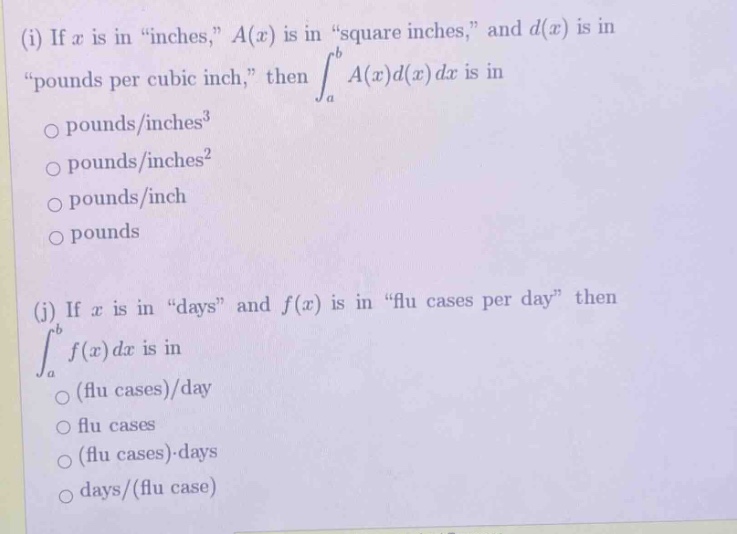
(i) if x is in “inches,” a(x) is in “square inches,” and d(x) is in “pounds per cubic inch,” then ∫a to b a(x)d(x)dx is in\no pounds/inches³\no pounds/inches²\no pounds/inch\no pounds\n\n(j) if x is in “days” and f(x) is in “flu cases per day” then ∫a to b f(x)dx is in\no (flu cases)/day\no flu cases\no (flu cases)·days\no days/(flu case)
Answer
Explanation:
Step1: Analizar unidades en (i)
Tenemos $A(x)$ en "square - inches" ($in^{2}$) y $d(x)$ en "pounds per cubic inch" ($\frac{lb}{in^{3}}$), y $dx$ en "inches" ($in$). Entonces $A(x)d(x)dx$ tiene unidades $in^{2}\times\frac{lb}{in^{3}}\times in$.
Step2: Simplificar unidades en (i)
$in^{2}\times\frac{lb}{in^{3}}\times in=\frac{in^{2}\times lb\times in}{in^{3}} = lb$ (pounds).
Step3: Analizar unidades en (j)
Tenemos $f(x)$ en "flu cases per day" ($\frac{casos\ de\ gripe}{día}$) y $dx$ en "days" ($día$). Entonces $\int_{a}^{b}f(x)dx$ tiene unidades $\frac{casos\ de\ gripe}{día}\times día$.
Step4: Simplificar unidades en (j)
$\frac{casos\ de\ gripe}{día}\times día = casos\ de\ gripe$.
Answer:
(i) pounds (j) flu cases