c. if f and g increase on an interval, then the product fg also increases on that interval. d. if a rational…
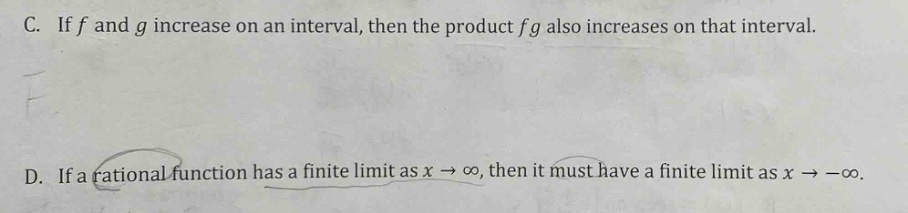
c. if f and g increase on an interval, then the product fg also increases on that interval. d. if a rational function has a finite limit as x → ∞, then it must have a finite limit as x → -∞.
Answer
Explanation:
Step1: Analyze statement C
Let (f(x)=x) and (g(x)=x) on the interval ((- \infty,0)). Both (f(x)) and (g(x)) are increasing on ((-\infty,0)) since (f^\prime(x) = 1>0) and (g^\prime(x)=1 > 0) for all (x\in(-\infty,0)). But ((fg)(x)=x^{2}), and ((fg)^\prime(x)=2x<0) for (x\in(-\infty,0)), so (fg) is decreasing on ((-\infty,0)). Thus, statement C is false.
Step2: Analyze statement D
Let (y = \frac{a_nx^n+\cdots+a_0}{b_mx^m+\cdots + b_0}) be a rational - function. If (\lim_{x\rightarrow\infty}y = L) (a finite limit), then (n\leq m). When (x\rightarrow-\infty), we have (\lim_{x\rightarrow-\infty}\frac{a_nx^n+\cdots+a_0}{b_mx^m+\cdots + b_0}). If (n < m), (\lim_{x\rightarrow-\infty}\frac{a_nx^n+\cdots+a_0}{b_mx^m+\cdots + b_0}=0). If (n = m), (\lim_{x\rightarrow-\infty}\frac{a_nx^n+\cdots+a_0}{b_mx^m+\cdots + b_0}=\frac{a_n}{b_m}) (because (x^n/x^m = 1) when (n = m)). So if a rational function has a finite limit as (x\rightarrow\infty), it must have a finite limit as (x\rightarrow-\infty). Statement D is true.
Answer:
C is false, D is true.