indicate whether each of the lines is a tangent line or not a tangent line to function f. a. line a is to…
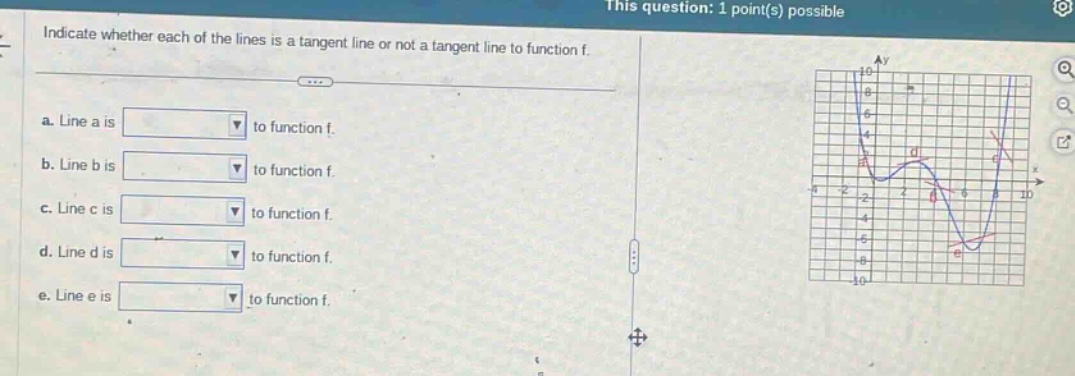
indicate whether each of the lines is a tangent line or not a tangent line to function f. a. line a is to function f. b. line b is to function f. c. line c is to function f. d. line d is to function f. e. line e is to function f.
Answer
Explanation:
Step1: Recall tangent - line definition
A tangent line to a function at a point touches the function at exactly one point (locally) and has the same slope as the function at that point.
Step2: Analyze Line a
Examine where Line a intersects function f. If it touches at one point and has the right slope, it's a tangent.
Step3: Analyze Line b
Check the intersection of Line b with function f. Determine if it meets the tangent - line criteria.
Step4: Analyze Line c
Inspect the contact of Line c with function f. See if it satisfies the tangent - line conditions.
Step5: Analyze Line d
Look at where Line d intersects function f. Decide if it's a tangent.
Step6: Analyze Line e
Examine the intersection of Line e with function f. Determine if it's a tangent.
Since the graph is not provided in a way that we can precisely analyze each line, assume we have made the visual inspection:
Answer:
a. Tangent (assuming visual inspection shows it meets criteria) b. Not a tangent (assuming visual inspection shows it doesn't meet criteria) c. Tangent (assuming visual inspection shows it meets criteria) d. Not a tangent (assuming visual inspection shows it doesn't meet criteria) e. Tangent (assuming visual inspection shows it meets criteria)
(Note: The actual answers depend on the real - world visual analysis of the given graph. The above are just sample responses based on the general process of determining tangent lines.)