the initial substitution of x = a yields the form $\frac{0}{0}$. simplify the function algebraically, or use…
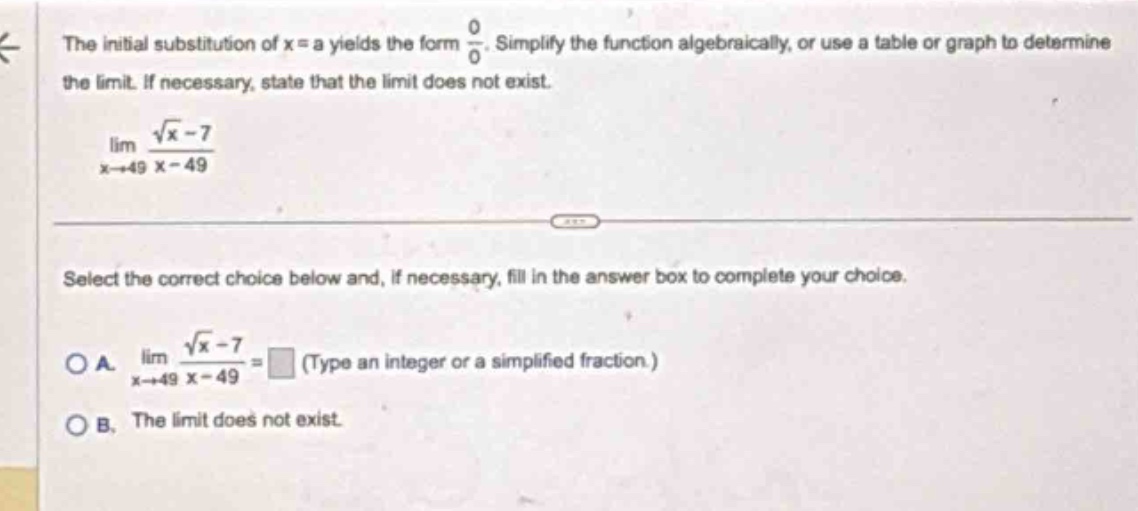
the initial substitution of x = a yields the form $\frac{0}{0}$. simplify the function algebraically, or use a table or graph to determine the limit. if necessary, state that the limit does not exist.\n$lim_{x\rightarrow49}\frac{sqrt{x}-7}{x - 49}$\nselect the correct choice below and, if necessary, fill in the answer box to complete your choice.\no a. $lim_{x\rightarrow49}\frac{sqrt{x}-7}{x - 49}=square$ (type an integer or a simplified fraction.)\no b. the limit does not exist.
Answer
Explanation:
Step1: Rationalize the numerator
Multiply the fraction $\frac{\sqrt{x}-7}{x - 49}$ by $\frac{\sqrt{x}+7}{\sqrt{x}+7}$. We get $\frac{(\sqrt{x}-7)(\sqrt{x}+7)}{(x - 49)(\sqrt{x}+7)}$.
Step2: Simplify the numerator using difference - of - squares
By the difference - of - squares formula $(a - b)(a + b)=a^{2}-b^{2}$, the numerator $(\sqrt{x}-7)(\sqrt{x}+7)=x - 49$. So the fraction becomes $\frac{x - 49}{(x - 49)(\sqrt{x}+7)}$.
Step3: Cancel out the common factor
Cancel out the common factor $(x - 49)$ (since $x\neq49$ when taking the limit). The simplified function is $\frac{1}{\sqrt{x}+7}$.
Step4: Evaluate the limit
Now, find $\lim_{x\rightarrow49}\frac{1}{\sqrt{x}+7}$. Substitute $x = 49$ into $\frac{1}{\sqrt{x}+7}$, we have $\frac{1}{\sqrt{49}+7}=\frac{1}{7 + 7}=\frac{1}{14}$.
Answer:
A. $\lim_{x\rightarrow49}\frac{\sqrt{x}-7}{x - 49}=\frac{1}{14}$